

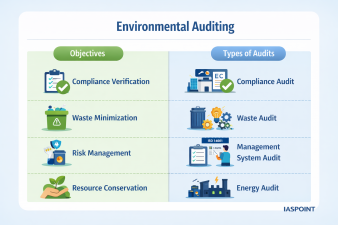
Environmental Auditing is a systematic, documented, periodic, and objective evaluation of how well an organization, management, and equipment are performing with the aim of safeguarding the environment. In the context of the Indian regulatory framework, it serves as a “post-project” check to ensure that the conditions of the Environmental Clearance (EC) and Consent to Operate (CTO) are being met.
Objectives of Environmental Auditing
- Compliance Verification: To ensure the project adheres to the standards set by the Air and Water Acts and the Environment (Protection) Act.
- Waste Minimization: Identifying areas where raw materials are being wasted and suggesting ways to recycle or reuse by-products.
- Risk Management: Detecting potential leaks, spillages, or equipment failures before they cause an environmental disaster.
- Resource Conservation: Evaluating the efficiency of water and energy consumption.
Types of Environmental Audits
Industries in India typically undergo different types of audits depending on the regulatory demand or internal corporate policy.
| Type of Audit | Primary Focus | Conducted By |
| Compliance Audit | Checking adherence to laws and EC conditions. | External auditors or SPCB. |
| Waste Audit | Identifying sources of waste and ways to reduce them. | Internal technical teams. |
| Management System Audit | Evaluating the effectiveness of the EMS (ISO 14001). | Accredited certification bodies. |
| Energy Audit | Assessing energy consumption and efficiency. | Bureau of Energy Efficiency (BEE) certified auditors. |
Statutory Requirement in India: The Environmental Statement
Under the Environment (Protection) Rules, 1986, it is mandatory for every person carrying on an industry, operation, or process requiring consent under the Water or Air Act to submit an Environmental Statement (formerly known as an Environmental Audit Report).
- Form V: This is the prescribed format for the environmental statement.
- Submission Deadline: It must be submitted on or before the 30th of September every year to the concerned State Pollution Control Board (SPCB).
- Coverage: It includes data on water and raw material consumption, pollution discharged to the environment, hazardous waste generation, and the impact of pollution control measures on the cost of production.
The Auditing Process
The process is generally divided into three phases to ensure a comprehensive review of the facility.
1. Pre-Audit Stage
- Defining the scope and objectives of the audit.
- Selecting the audit team and gathering basic information about the plant’s processes.
- Reviewing previous audit reports and compliance history.
2. On-Site Audit Stage
- Physical Inspection: Checking the status of the Effluent Treatment Plant (ETP), Air Pollution Control Devices (APCD), and waste storage areas.
- Data Verification: Reviewing logbooks for fuel consumption, water meter readings, and waste disposal manifests.
- Interviews: Talking to plant personnel to gauge their awareness of environmental protocols.
3. Post-Audit Stage
- Reporting: Drafting the audit findings, highlighting “non-compliances” (NCs).
- Action Plan: The industry prepares a “Corrective Action Plan” (CAP) to address the deficiencies found.
- Follow-up: Checking if the suggested improvements have been implemented in the next cycle.
Benefits for Industry and Government
- For the Industry: Leads to “Green Image” building, reduction in utility bills (water/power), and immunity from heavy penalties or closure notices.
- For the Government: Provides a “State of the Environment” report for industrial clusters, helping in regional planning and policy formulation.
- For the Public: Ensures that the “Polluter Pays Principle” is enforced and that local resources are being used responsibly.
Limitations and Challenges
- Self-Reporting Bias: Since the Environmental Statement is often self-prepared by the industry, there is a tendency to under-report pollution levels.
- Lack of Verification: SPCBs often lack the manpower to physically verify every Form V submitted by thousands of industries.
- Qualitative Nature: Many audits focus on the “existence” of a system (e.g., “Does an ETP exist?”) rather than its “efficiency” (e.g., “Is the ETP actually meeting the BOD standards 24/7?”).
Trivia for UPSC Prelims
- ISO 14001: This is the international standard for Environmental Management Systems (EMS). While not mandatory by law, many Indian exporters adopt it to meet global market requirements.
- Energy Audit Mandatory: Under the Energy Conservation Act, 2001, certain “Designated Consumers” (heavy industries like Iron & Steel, Cement) are mandated to conduct regular energy audits.
- The 30th September Rule: In UPSC Prelims, specific dates like the submission of the Environmental Statement (Form V) by September 30th are significant “fact-check” points.
- Public Disclosure: Under the RTI Act and various NGT orders, environmental audit data is generally considered public information and cannot be hidden under “commercial confidentiality.”