
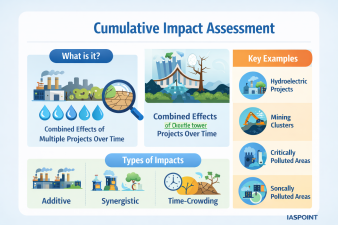
Cumulative Impact Assessment is the process of evaluating the successive, incremental, and combined effects of multiple projects or activities on the environment over time. While a standard EIA looks at a project in isolation, CIA acknowledges that the “carrying capacity” of an ecosystem may be breached by the collective stress of several developments, even if each project’s individual impact is within permissible limits.
Conceptual Framework: The “Death by a Thousand Cuts”
The core philosophy of CIA is that environmental degradation often results not from a single large event, but from the accumulation of several smaller, seemingly insignificant actions.
- Additive Impacts: Simple solar addition of similar impacts (e.g., three factories each consuming 1 million liters of water, totaling 3 million liters from a single aquifer).
- Synergistic Impacts: When two different impacts interact to create a greater total effect (e.g., a chemical plant’s effluent reacting with a thermal power plant’s warm water discharge to create a toxic bloom).
- Time-Crowding: When impacts occur so frequently that the environment does not have time to recover.
- Space-Crowding: When projects are so close together that their impact zones overlap.
CIA vs. Project-Level EIA
| Feature | Project-Level EIA | Cumulative Impact Assessment (CIA) |
| Focus | Individual project footprint. | Regional or Basin-wide footprint. |
| Boundary | Project site + 10 km radius. | Ecological boundaries (e.g., entire river basin). |
| Baseline | Static current environment. | Trends over time (past, present, and future). |
| Responsibility | Project Proponent. | Usually Government or a Group of Developers. |
Key Applications in India
CIA has become a legal and administrative necessity in specific sectors where industrial “clustering” is common.
1. Hydroelectric Projects (River Basin Studies)
In the Himalayas (e.g., Alaknanda, Bhagirathi, and Teesta basins), a series of “run-of-the-river” projects are often built in a cascade. A CIA is required to ensure that the “Environmental Flow” (e-flow) of the river is maintained to support aquatic life between the dams.
2. Mining Clusters
In states like Odisha, Jharkhand, and Chhattisgarh, multiple coal or iron ore mines operate in the same geographic belt. CIA evaluates the combined impact on the local water table, forest fragmentation, and the health of tribal populations.
3. Critically Polluted Areas (CPAs)
The CPCB identifies industrial clusters (like Vapi, Pali, or Singrauli) where the Comprehensive Environmental Pollution Index (CEPI) is very high. In these areas, new projects are often restricted based on a CIA of the existing load.
The CIA Methodology
The process is more complex than a standard EIA and involves several distinct steps:
- Scoping the Boundaries: Defining the VECs (Valued Environmental Components) such as a specific endangered species, a primary aquifer, or local air quality.
- Establishing the Geographic and Temporal Scope: Looking back at the historical state of the environment and looking forward to all “reasonably foreseeable” future projects.
- Assessing Baseline Trends: Not just a snapshot, but an analysis of how the VECs have changed over the last decade.
- Quantifying Combined Stress: Using GIS (Geographic Information Systems) and regional modeling to map the overlapping impact zones.
- Management Strategy: Recommending regional mitigation measures, such as a Common Effluent Treatment Plant (CETP) or a regional wildlife corridor.
Judicial and Regulatory Status in India
- National Green Tribunal (NGT): The NGT has been a major proponent of CIA. In several landmark judgments, it has stayed clearances for individual dams or mines, ordering the MoEFCC to first conduct a “Carrying Capacity” or “Basin-wide” study.
- EIA Notification Amendments: Recent guidelines emphasize that for projects in specific sectors (like thermal power or mining), the Expert Appraisal Committee (EAC) can mandate a CIA if there are other similar projects within a specific radius.
- Wildlife Corridors: The National Board for Wildlife (NBWL) often uses CIA principles to assess how multiple linear infrastructure projects (roads, rails, power lines) collectively block animal movement.
Challenges in Implementation
- Data Sharing: Project proponents are often reluctant to share data with competitors, making a combined assessment difficult.
- Institutional Ownership: Since a CIA covers multiple projects, it is often unclear who should pay for and conduct the study—the government or the developers.
- Predictive Uncertainty: Predicting future projects and their impacts involves a high degree of uncertainty compared to a fixed project design.
Trivia for UPSC Prelims
- Valued Environmental Components (VECs): These are the “entities” (like the Great Indian Bustard or the Ganga River) that the CIA specifically aims to protect from cumulative stress.
- CEPI (Comprehensive Environmental Pollution Index): A score used by CPCB to categorize industrial clusters; a score above 70 classifies an area as a “Critically Polluted Area.”
- Environmental Flow (E-flow): The minimum quantity, timing, and quality of water flow required to sustain freshwater ecosystems and the human livelihoods that depend on them.
- Synergistic Effect: A phenomenon where the combined effect of two pollutants is greater than the sum of their individual effects; CIA is the only tool that effectively captures this.