
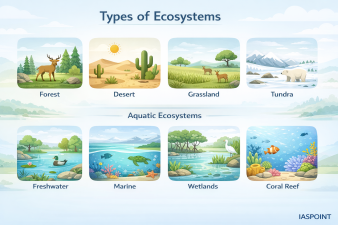
Ecosystems are broadly classified based on their habitat, climate, and the degree of human intervention. The two primary categories are Natural Ecosystems, which operate under natural conditions without major human interference, and Artificial Ecosystems, which are managed by humans.
Terrestrial Ecosystems (Land-based)
Terrestrial ecosystems are categorized primarily based on the dominant vegetation, which is determined by temperature and precipitation patterns.
Forest Ecosystems
Forests cover roughly 31% of the world’s land area and are characterized by a high density of trees.
- Tropical Rainforests: Located near the equator; high rainfall and temperature year-round. They possess the highest biodiversity and multi-layered canopies.
- Tropical Deciduous Forests: Common in India (Monsoon forests). Trees shed leaves seasonally to conserve water.
- Temperate Coniferous Forests (Taiga/Boreal): Dominated by needle-leaf evergreen trees like Pine and Spruce; adapted to cold climates.
Grassland Ecosystems
Areas where the vegetation is dominated by grasses rather than large trees or shrubs.
- Tropical Grasslands (Savannah): Characterized by a warm climate and distinct wet and dry seasons (e.g., East African Savannah).
- Temperate Grasslands (Steppes/Prairies): Found in mid-latitudes; highly fertile soil, often converted into “granaries of the world.”
Desert Ecosystems
Defined by extremely low precipitation (less than 25 cm annually).
- Hot Deserts: High daytime temperatures (e.g., Thar, Sahara). Flora includes succulents like Cacti with deep roots and waxy coatings.
- Cold Deserts: High altitude or high latitude regions (e.g., Gobi, Ladakh).
Tundra Ecosystems
Found in the Arctic and high mountain tops (Alpine Tundra). They are characterized by a “permafrost” layer (permanently frozen subsoil). Vegetation is limited to mosses, lichens, and small shrubs.
Aquatic Ecosystems (Water-based)
Aquatic ecosystems are classified based on the salinity levels of the water.
Freshwater Ecosystems
Salinity is very low (less than 0.5 ppt).
- Lentic (Standing water): Lakes, ponds, and swamps.
- Lotic (Running water): Rivers, streams, and springs.
- Wetlands: Areas where the water table is at or near the surface (e.g., Marshes, Bogs).
Marine Ecosystems
Salinity is high (averaging 35 ppt). They cover about 71% of the Earth’s surface.
- Oceans: Deepwater systems divided into zones (Intertidal, Pelagic, Benthic, Abyssal).
- Coral Reefs: Known as the “Rainforests of the Sea” due to immense biodiversity; formed by calcium carbonate skeletons of polyps.
- Estuaries: Coastal regions where freshwater from rivers meets saltwater from the sea; highly productive ecotones.
Comparison of Ecosystem Types
| Feature | Terrestrial | Aquatic (Freshwater) | Marine |
| Primary Limiting Factor | Moisture and Temperature | Dissolved Oxygen and Light | Salinity and Nutrients |
| Nutrient Source | Soil and Atmosphere | Runoff from land | Upwelling and land runoff |
| Stability | High fluctuations | Moderate stability | High thermal stability |
Artificial or Man-Made Ecosystems
These are created and maintained by human intervention to meet specific needs. They lack the self-regulatory mechanisms (homeostasis) of natural ecosystems.
- Agro-ecosystems: Crop fields (e.g., Rice, Wheat). They are monocultures and require external inputs like fertilizers and pesticides.
- Aquaculture: Fish farms or shrimp ponds managed for food production.
- Urban Ecosystems: Cities and towns where the environment is heavily modified by infrastructure.
- Space Ecosystems: Enclosed life-support systems used in spacecraft.
Important Concepts for UPSC Prelims
- Biosphere: The global sum of all ecosystems; the zone of life on Earth.
- Biomes: Large regional units characterized by a major vegetation type and associated fauna (e.g., Tropical Rainforest Biome). Biomes are larger than ecosystems.
- Primary Productivity: Marine ecosystems generally have lower primary productivity per unit area compared to terrestrial ecosystems like Tropical Rainforests, though oceans contribute significantly to global productivity due to their vast size.
- Deep Sea Hydrothermal Vents: Unique ecosystems that do not depend on sunlight; producers here are chemosynthetic bacteria that derive energy from sulfur compounds.
Ecosystem Services (Classification)
Ecosystems provide various “services” classified by the Millennium Ecosystem Assessment:
- Provisioning: Food, water, timber, fiber.
- Regulating: Climate regulation, flood control, water purification.
- Cultural: Aesthetic, spiritual, educational.
- Supporting: Nutrient cycling, soil formation, primary production.