
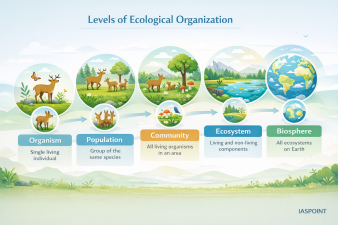
Ecological organization follows a biological hierarchy ranging from the individual organism to the entire planet.
1. Individual (Organism)
The individual is the basic unit of study in ecology. It refers to a single living being that has the ability to act or function independently.
- Key Characteristics: Individuals possess specific physiological and behavioral adaptations to survive in their environment.
- Focus of Study: At this level, ecology examines how an individual responds to abiotic factors like temperature, moisture, and light.
2. Population
A population is a group of individuals belonging to the same species, inhabiting a specific geographical area at a particular time, and capable of interbreeding.
- Population Density: The number of individuals per unit area or volume.
- Growth Patterns: Influenced by birth rate (natality), death rate (mortality), immigration, and emigration.
- Genetic Diversity: Populations are the primary level where evolutionary changes and natural selection occur.
3. Community
An ecological community consists of all the populations of different species that live and interact within a defined area.
- Interspecific Interactions: Communities are characterized by relationships such as predation, competition, mutualism, commensalism, and parasitism.
- Structure: Named after the dominant plant form (e.g., a grassland community).
- Succession: The gradual process by which the species composition of a community changes over time (Primary vs. Secondary succession).
4. Ecosystem
An ecosystem is a functional unit where living organisms (biotic) interact among themselves and with their physical environment (abiotic).
- Components: Includes nutrient cycles (biogeochemical cycles) and energy flow (food chains and food webs).
- Types: Natural (forests, oceans) or Artificial (croplands, aquariums).
- Boundaries: Ecosystems do not have discrete boundaries; they overlap via ecotones.
5. Biome
A biome is a large regional unit characterized by a specific climate (temperature and precipitation) and distinct vegetation and animal life.
- Classification: Primarily determined by climate. Major biomes include Tundra, Taiga, Temperate Deciduous Forest, Tropical Rainforest, Savannah, and Desert.
- Terrestrial vs. Aquatic: While “biome” usually refers to terrestrial systems, aquatic systems are often categorized as “aquatic zones” (freshwater vs. marine).
6. Biosphere
The biosphere is the highest level of organization. It is the “zone of life” on Earth, representing the sum total of all ecosystems.
- Extent: It extends from the deepest ocean trenches to several kilometers into the atmosphere.
- Function: It is a closed system for matter but an open system for energy (solar radiation).
Summary Table: Levels of Organization
| Level | Definition | Focus of Study |
| Individual | A single living organism. | Survival and adaptation. |
| Population | Same species in a specific area. | Population dynamics and evolution. |
| Community | Different species interacting. | Competition, predation, and symbiosis. |
| Ecosystem | Biotic and Abiotic interaction. | Energy flow and nutrient cycling. |
| Biome | Regional climate-based unit. | Global distribution of flora and fauna. |
| Biosphere | Global sum of all ecosystems. | Global cycles and planetary health. |
Important Ecological Concepts for UPSC
The Edge Effect
This occurs at the boundary (Ecotone) of two levels of organization or ecosystems. The species diversity and density are often higher in these transition zones than in either of the flanking communities. Common examples include the interface between a forest and a grassland.
Keystone Species
A species that has a disproportionately large effect on its environment relative to its abundance. If a keystone species is removed, the entire community structure or ecosystem level may collapse (e.g., Sea Otters in kelp forests or Tigers in Indian forests).
Ecological Niche vs. Habitat
- Habitat: The “address” or physical place where an organism lives.
- Niche: The “profession” or functional role of the organism, including its trophic position and timing of activity. No two species in a stable community can occupy the same niche indefinitely.