
Population regulation refers to the process by which the size of a population is kept within certain bounds, preventing both extinction and infinite growth. While population growth describes how numbers increase, regulation focuses on the factors that stabilize a population near its carrying capacity (K).
Density-Dependent Regulation
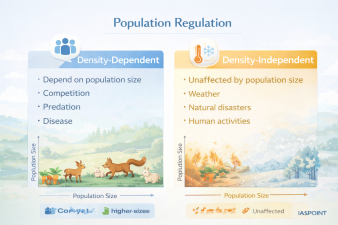
Density-dependent factors are biological in nature (biotic) and act as negative feedback loops. Their intensity increases as the population density rises, effectively slowing growth.
- Intraspecific Competition: Individuals of the same species compete for limited resources like food, nesting sites, and mates. This is the primary regulator of population size.
- Predation: As prey density increases, predators can find prey more easily (functional response) or predator numbers increase (numerical response), which in turn reduces the prey population.
- Disease and Parasitism: High-density populations facilitate the rapid spread of pathogens and parasites. Stress from overcrowding can also weaken the immune systems of individuals.
- Waste Accumulation: In closed systems or high-density colonies, the accumulation of metabolic wastes (e.g., ammonia in fish ponds or ethanol in yeast cultures) can reach toxic levels, limiting further growth.
Density-Independent Regulation
Density-independent factors affect the population size regardless of how many individuals are present. These are typically abiotic (physical or chemical) factors.
- Climatic Events: Sudden frost, heatwaves, or unseasonal rains can cause mass mortality irrespective of population density.
- Natural Disasters: Volcanic eruptions, wildfires, tsunamis, and floods act as catastrophic regulators.
- Anthropogenic Factors: Large-scale habitat destruction, pollution, or pesticide application can decimate populations regardless of their initial size.
Top-Down vs. Bottom-Up Control
Ecologists categorize population regulation based on which trophic level exerts the most influence.
Bottom-Up Control
The population size is regulated by the availability of resources (nutrients and food) at the base of the food chain.
- Example: In an ocean ecosystem, the amount of phytoplankton (primary producers) limits the population of zooplankton, which in turn limits the fish population.
Top-Down Control (The Trophic Cascade)
The population size is regulated by predation from the upper trophic levels.
- Example: The reintroduction of wolves in Yellowstone National Park regulated the elk population, which had previously overgrazed the vegetation. This is often called a “Trophic Cascade.”
Table: Comparison of Regulatory Factors
| Feature | Density-Dependent | Density-Independent |
| Nature of Factor | Biotic (Biological) | Abiotic (Physical) |
| Feedback Mechanism | Negative Feedback (Stabilizing) | No Feedback (Random/Catastrophic) |
| Primary Examples | Competition, Predation, Disease | Weather, Fire, Floods, Pollutants |
| Effect on Mortality | Mortality rate increases with density | Mortality rate is constant regardless of density |
Specialized Regulatory Phenomena
The Allee Effect
While most regulation deals with overcrowding, the Allee Effect describes a situation where a population’s growth rate decreases when the density is too low.
- Causes: Difficulty in finding mates, breakdown of social structures (e.g., pack hunting in African Wild Dogs), or increased vulnerability to predators.
- Prelims Fact: The Allee Effect is a major concern for the conservation of endangered species, as a population may crash even if some individuals remain.
Population Oscillations and Cycles
Some populations do not remain steady at carrying capacity but undergo regular fluctuations.
- Boom-and-Bust Cycles: Common in r-strategists like locusts or lemmings.
- Predator-Prey Cycles: Classic example of the Lynx and Snowshoe Hare, where the prey population peaks, followed by a predator peak, which then causes a prey crash.
UPSC Prelims Fact Sheet
- Self-Thinning: A phenomenon in plant ecology where, as individual plants grow larger, the density of the population decreases because they compete for light and nutrients.
- Homeostasis: The tendency of a population to maintain a stable size despite environmental fluctuations through internal regulatory mechanisms.
- Metapopulations: A network of semi-isolated populations of the same species. Regulation occurs through the balance of local extinctions and recolonization (immigration/emigration).
- Intrinsic Rate of Increase (r): When regulation is absent and resources are infinite, a population grows at its maximum r. Regulation acts by reducing the realized growth rate below this potential.