
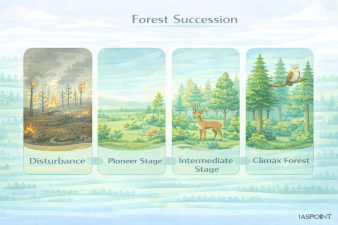
Ecological succession is the gradual and predictable process of change in the species structure of an ecological community over time. In a forest ecosystem, this represents the transition from a barren area or a disturbed patch of land to a stable, complex climax forest. This process is driven by the interaction between biotic communities and their physical environment.
Types of Succession
Ecological succession is broadly categorized based on the starting conditions of the terrain.
Primary Succession
- Definition: Occurs in essentially lifeless areas where the soil is incapable of sustaining life due to a lack of nutrients (e.g., bare rock, sand dunes, or cooled lava flows).
- Pioneer Species: The first organisms to colonize these areas are typically lichens and mosses. Lichens secrete acids to break down rock into soil.
- Timeline: Extremely slow, often taking hundreds to thousands of years to reach a forest stage because soil formation is a prerequisite.
Secondary Succession
- Definition: Occurs in areas where a biological community has existed but was removed by disturbances such as forest fires, floods, or deforestation (logging).
- Pioneer Species: Grasses, weeds, and herbaceous plants. Unlike primary succession, the soil is already present and often contains a “seed bank.”
- Timeline: Significantly faster than primary succession, reaching a climax state in a few decades to a century.
Stages of Forest Succession (Seral Stages)
The entire sequence of communities that successively change in a given area are called Seral Stages or Seres.
1. Nudation
The development of a bare area without any form of life. This can be caused by topographic factors (erosion), climatic factors (glaciers), or biotic factors (human activity).
2. Invasion (Migration and Ecesis)
- Migration: Seeds, spores, or propagules reach the bare area via wind, water, or animals.
- Ecesis (Establishment): The successful establishment of a species in the new area. The pioneer species must survive and reproduce under harsh conditions.
3. Competition and Coaction
As the population increases, individual species compete for limited resources like space, sunlight, nutrients, and water. This stage involves “coaction,” where organisms influence each other’s environment.
4. Reaction
The most critical stage where the existing organisms modify the environment. For example, the accumulation of organic matter (humus) changes the soil’s acidity and water-holding capacity, making the area less favorable for themselves and more suitable for new, more demanding species.
5. Stabilization (Climax Community)
The final stage where the community reaches an equilibrium with the local climate. This stage is known as the Climax Community.
- Characteristics: High species diversity, complex food webs, and stable biomass.
- In India: Examples include the Tropical Wet Evergreen forests of the Western Ghats.
Successional Trends in Vegetation
As a forest progresses from pioneer stages to a climax stage, several predictable changes occur:
| Feature | Pioneer Stage | Climax Stage |
| Species Diversity | Low | High |
| Food Web | Simple/Linear | Complex/Web-like |
| Niche Breadth | Generalist (Broad) | Specialist (Narrow) |
| Nutrient Cycling | Rapid / Open | Slow / Closed |
| Net Community Production | High | Low (near zero at equilibrium) |
| Stability | Low | High |
Classification Based on Water Availability
Ecological succession is also classified based on the nature of the environment where it originates:
- Hydrarch (Hydrosere): Succession starting in water bodies (ponds, lakes) leading to mesic (moist) forest conditions.
- Xerarch (Xerosere): Succession starting in dry areas (bare rocks, deserts) leading to mesic forest conditions.
- Note: Both Hydrarch and Xerarch successions ultimately lead to a medium-sized forest (Mesic) environment.
Important Facts for UPSC Prelims
- Seral Community: An intermediate stage found in ecological succession in an ecosystem advancing towards its climax community.
- Autogenic Succession: Driven by the biotic components of the ecosystem itself (e.g., plants changing soil pH).
- Allogenic Succession: Driven by external abiotic factors (e.g., volcanic eruptions or climate change).
- Retrogressive Succession: When a community degrades (e.g., from a forest back to a grassland) due to persistent disturbance like heavy overgrazing or recurrent fires.
- Lithosere: A succession that begins on a bare rock surface.
- Psammosere: A succession that begins on sand dunes.