

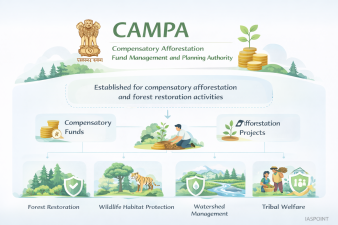
The Compensatory Afforestation Fund Management and Planning Authority (CAMPA) was established to manage the funds collected as compensation for the diversion of forest land for non-forest purposes (such as mining, industry, or infrastructure).
- Legal Basis: It was initially created by the Supreme Court in 2002 but gained permanent statutory status through the Compensatory Afforestation Fund (CAF) Act, 2016.
- The “Net Present Value” (NPV) Concept: The core principle is that when forest land is diverted, the user agency must pay for the ecological value lost. This includes the cost of compensatory afforestation and the NPV of the diverted forest.
- Nodal Ministry: Ministry of Environment, Forest and Climate Change (MoEFCC).
The Two-Tier Fund Structure
Under the CAF Act 2016, the money collected is distributed between the National and State levels to ensure decentralized implementation.
| Fund Level | Share of Collection | Role and Governance |
|---|---|---|
| National Fund | 10% | Maintained under the Public Account of India; monitored by a National Authority for oversight and inter-state coordination. |
| State Fund | 90% | Maintained under the Public Account of the respective State; used for actual field execution of afforestation and conservation projects. |
Key Components of CAMPA Payments
When a project proponent (private or public) diverts forest land, they are liable to pay into the fund under three main heads:
- Compensatory Afforestation (CA): Cost of planting trees on an equivalent area of non-forest land or double the area of degraded forest land.
- Net Present Value (NPV): A mandatory one-time payment based on the ecosystem services provided by the forest (timber, carbon sequestration, soil conservation, etc.). Rates vary based on the eco-class and density of the forest.
- Catchment Area Treatment (CAT) Plan: Payments for specific measures to reduce soil erosion and siltation in the catchment areas of hydro-projects.
Permissible Activities under CAMPA
The funds are “non-lapsable” and strictly earmarked for activities that enhance India’s green cover and wildlife habitat.
Core Forestry Activities
- Artificial regeneration (plantations) and assisted natural regeneration.
- Forest management, protection, and fire control measures.
- Silvicultural operations and nursery development.
Wildlife and Infrastructure
- Implementation of the Wildlife Management Plan.
- Relocation of villages from protected areas (National Parks/Sanctuaries).
- Soil and moisture conservation works in forest areas.
Prohibited Uses
- Payment of salaries and medical expenses of forest department staff.
- Creation of office buildings or residential quarters for staff.
- Purchase of luxury vehicles.
Governance Structure
National Authority
- Chairperson: Union Minister for Environment, Forest and Climate Change.
- Role: To manage the National Fund and provide technical assistance to State Authorities.
State Authority
- Governing Body: Chaired by the Chief Minister of the State.
- Steering Committee: Chaired by the Chief Secretary.
- Executive Committee: Chaired by the Principal Chief Conservator of Forests (PCCF).
UPSC Prelims: Critical Facts and Trivia
- Non-Lapsable: Unlike many government funds, CAMPA funds do not expire at the end of the financial year.
- Kanchan Chopra Committee: This committee was instrumental in formulating the methodology for calculating the Net Present Value (NPV) of forests.
- Supreme Court Oversight: The ad-hoc CAMPA functioned for years under SC supervision before the 2016 Act formalized the permanent structure.
- Audit: The accounts of both National and State Authorities are subject to audit by the Comptroller and Auditor General (CAG) of India.
Major Challenges and Criticisms
- Land Availability: Finding suitable non-forest land for compensatory afforestation remains a hurdle, often leading to plantations on existing “degraded forests” which doesn’t result in net gain of forest area.
- Monoculture Issues: Many CAMPA projects have been criticized for planting commercial monocultures (like Eucalyptus or Teak) instead of biodiverse native forests.
- Conflict with Forest Rights Act (FRA): There are ongoing concerns that CAMPA plantations are sometimes carried out on lands claimed by tribals under the FRA without the consent of the Gram Sabha.
- Fund Underutilization: Large sums of money often remain unspent in the Public Accounts of states due to a lack of technical planning or administrative delays.