

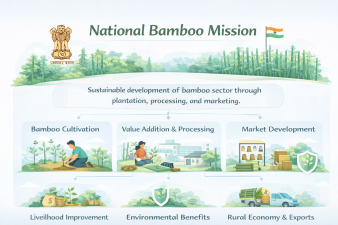
The National Bamboo Mission (NBM) was initially launched in 2006-07 as a Centrally Sponsored Scheme. It was later restructured and relaunched in 2018-19 to focus on the development of the entire value chain of the bamboo sector. It currently operates under the Ministry of Agriculture and Farmers Welfare.
- Objective Shift: The mission moved from being “plantation-centric” to “product-centric,” linking farmers directly to markets and industries.
- Funding Pattern: For North Eastern and Himalayan states, the ratio is 90:10 (Centre:State); for other states, it is 60:40. For Union Territories, it is 100% centrally funded.
The “Green Gold”: Legal Status of Bamboo
A pivotal change that fueled the mission was the amendment to the Indian Forest Act, 1927 in 2017.
- Reclassification: Bamboo grown in non-forest areas was removed from the definition of “tree.”
- Transit Permits: Prior to this, cutting and transporting bamboo required a transit permit even if grown on private land. Now, farmers can cultivate, harvest, and transport bamboo grown outside forest areas without legal hurdles.
- Note for Prelims: Bamboo remains a “tree” under the law if it is grown within forest areas, and its harvest there is governed by the Forest Conservation Act and Forest Rights Act.
Strategic Objectives of NBM
The mission aims to increase the area under bamboo plantation in non-forest government and private lands to supplement farm income.
- Value Chain Development: Connecting growers with consumers through a cluster-based approach (hubs and spokes model).
- Employment Generation: Especially for skilled and unskilled persons, including unemployed youths in rural areas.
- Import Substitution: Reducing India’s dependence on imported bamboo products (like incense sticks/agarbatti) by boosting local production.
- Environmental Benefits: Promoting bamboo as a tool for carbon sequestration and soil erosion control.
Implementation Structure
The mission follows a cluster-based approach to ensure that the processing units are located near the plantation sites to reduce transportation costs.
| Level | Implementing Agency |
| National Level | National Bamboo Mission (NBM) under Department of Agriculture & Farmers Welfare. |
| State Level | State Bamboo Mission (SBM) / Bamboo Development Agency. |
| District Level | District level committees/Agencies involving local stakeholders. |
Key Focus Areas and Components
Research and Development
Focusing on the development of high-yielding, disease-resistant varieties and standardized cultivation practices suited for different agro-climatic zones.
Post-Harvest Management
Setting up of “Bamboo Bazars,” primary processing centers, treatment plants, and carbonization units to add value to the raw bamboo.
Product Development
Encouraging the use of bamboo in various sectors:
- Construction: Prefabricated houses and structural elements.
- Energy: Bamboo pellets for co-firing in thermal power plants and bio-ethanol.
- Handicrafts: Traditional furniture and daily-use products.
- Textiles: Bamboo fiber for clothing.
Important Facts for UPSC Prelims
- World Bamboo Day: Celebrated on September 18th.
- Bamboo Diversity: India is the second richest country in the world in bamboo genetic resources after China.
- Common Species: Bambusa bambos, Dendrocalamus strictus, and Bambusa balcooa are widely cultivated in India.
- Bamboo as Grass: Botanically, bamboo is a perennial flowering plant in the subfamily Bambusoideae of the grass family (Poaceae).
- Ethanol Production: India’s first bio-refinery for producing ethanol from bamboo is located in Numaligarh, Assam.
Challenges and Recent Initiatives
- Flowering Cycles: Gregarious flowering (where all bamboo of a species flowers and dies simultaneously) can lead to sudden loss of raw material and potential fire hazards.
- Bamboo Clusters: The government has identified several “Bamboo Clusters” in states like Madhya Pradesh, Maharashtra, Odisha, and North Eastern states to provide targeted financial assistance.
- Standardization: The Bureau of Indian Standards (BIS) is working to standardize bamboo products to ensure quality for the export market.
- Agarbatti Industry: In 2020, the government increased the import duty on bamboo sticks for agarbatti from 10% to 25% to encourage domestic bamboo farmers under the “Atmanirbhar Bharat” initiative.