
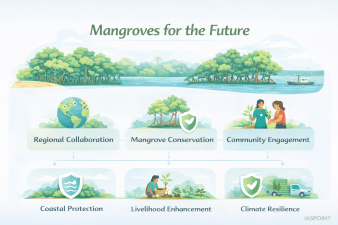
Mangroves for the Future (MFF) is a strategic, partner-led regional initiative aimed at promoting investment in coastal ecosystem conservation for sustainable development. Established in 2006, the initiative was a direct response to the devastating 2004 Indian Ocean Tsunami, which highlighted the critical role of healthy coastal ecosystems in protecting human lives and property.
Institutional Framework and Governance
The MFF operates as a multi-country collaborative platform, ensuring that coastal management is integrated across borders and sectors.
- Co-Chairs: The initiative is co-chaired by the International Union for Conservation of Nature (IUCN) and the United Nations Development Programme (UNDP).
- Outreach: While mangroves are the “flagship” species, the initiative covers all coastal ecosystems, including coral reefs, estuaries, lagoons, sandy beaches, seagrasses, and wetlands.
- Funding Partners: Major support is provided by the Norwegian Agency for Development Cooperation (NORAD), the Swedish International Development Cooperation Agency (SIDA), and the Danish International Development Agency (DANIDA).
- National Level Execution: Each member country manages its programme through a National Coordinating Body (NCB), which includes representatives from the government, NGOs, and the private sector.
Member Countries and Expansion
The MFF initially focused on the six countries most affected by the 2004 Tsunami and has since expanded to include other nations in South and Southeast Asia.
| Phase | Countries Included |
| Initial Members (2006) | India, Indonesia, Maldives, Seychelles, Sri Lanka, Thailand |
| Outreach Countries (Expanded) | Bangladesh, Cambodia, Myanmar, Pakistan, Vietnam |
Core Objectives and Strategy
The initiative is built on the principle of “investing in coastal ecosystems” as a form of natural infrastructure.
- Knowledge Generation: Strengthening the scientific database to assist in policy formulation for coastal and marine management.
- Empowerment: Building the capacity of local coastal communities to manage their resources sustainably.
- Coastal Governance: Improving the legal and institutional frameworks for integrated coastal zone management (ICZM).
- Climate Resilience: Promoting nature-based solutions (NbS) for climate change adaptation and disaster risk reduction (DRR).
India’s Engagement with MFF
India has been a member of MFF since its inception in 2006. The Ministry of Environment, Forest and Climate Change (MoEFCC) acts as the nodal agency.
- Priority States: In India, the MFF focuses on West Bengal, Odisha, Andhra Pradesh, Tamil Nadu, and Gujarat.
- Small Grant Facility (SGF): This is a key tool used in India to fund local-level projects focusing on livelihood diversification, such as sustainable aquaculture and eco-tourism in the Sundarbans and Gulf of Mannar.
- Alignment with National Schemes: MFF objectives complement India’s domestic initiatives like MISHTI (Mangrove Initiative for Shoreline Habitats & Tangible Incomes) launched in 2023, which aims at mangrove afforestation along the coastline using CAMPA funds and MGNREGS.
Technical Facts for UPSC Prelims
- Ecosystem Service Value: Mangroves sequester approximately 4 to 10 times more carbon per unit area than terrestrial tropical forests (Blue Carbon).
- Biological Filter: Mangrove roots act as natural filters, trapping sediments and absorbing excess nutrients (Nitrogen and Phosphorus) before they reach coral reefs.
- Pneumatophores: Specialized roots that allow mangroves to breathe in oxygen-poor (anaerobic) sediment.
- Viviparity: A unique reproductive trait where seeds germinate while still attached to the parent tree, allowing them to establish quickly in tidal mud.
- Global Distribution: Indonesia holds the largest mangrove cover in the world. India accounts for roughly 3% of the global mangrove area.
Comparison: MFF vs. Mangrove Alliance for Climate (MAC)
| Feature | Mangroves for the Future (MFF) | Mangrove Alliance for Climate (MAC) |
| Launched | 2006 (Post-Tsunami) | 2022 (COP27, Egypt) |
| Lead Entities | IUCN, UNDP | UAE and Indonesia |
| Focus | Holistic coastal ecosystem & livelihoods | Climate Change mitigation via carbon sinks |
| Geography | Indian Ocean and SE Asia | Global |
| India’s Status | Founding Member | Joined at COP27 |