
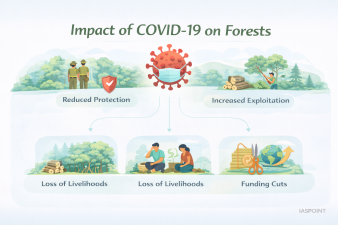
The COVID-19 pandemic exerted a dual impact on global and Indian forest ecosystems. While industrial activity slowed down, leading to temporary reductions in pollution, the socio-economic disruptions triggered increased pressure on forest resources due to reverse migration and weakened enforcement.
Negative Impacts on Forests and Biodiversity
The pandemic acted as a catalyst for deforestation and illegal extraction in several regions due to the “retreat of the state” during lockdowns.
- Increased Deforestation: Satellite data from platforms like Global Forest Watch indicated a spike in deforestation alerts in 2020 across the tropics (notably Brazil and SE Asia) as monitoring and enforcement by forest departments were curtailed.
- Fuelwood and NTFP Extraction: Lockdowns led to a surge in dependency on forests for fuelwood and Non-Timber Forest Products (NTFPs) as supply chains for LPG and commercial fuels were disrupted.
- Weakened Governance: Diversion of government funds and personnel toward pandemic relief weakened the surveillance against timber smuggling and poaching in protected areas.
- Encroachment: Economic distress prompted some communities to clear forest land for subsistence agriculture to ensure food security.
Socio-Economic Impact on Forest-Dependent Communities
Approximately 100 million forest dwellers in India depend on forests for food, shelter, and income. The pandemic severely tested their resilience.
- Reverse Migration Pressure: The mass exodus of urban laborers back to rural tribal belts (e.g., Jharkhand, Chhattisgarh, Odisha) increased the immediate “load” on local forest resources for survival.
- Loss of Income: The lockdown (March–June) coincided with the peak season for harvesting major NTFPs like Tendu leaves, Sal seeds, and Mahua flowers. Market closures prevented the auction and sale of these products, leading to massive financial losses for Gram Sabhas.
- Disruption of Tribal Markets (Haats): The closure of local weekly markets severed the primary link between tribal collectors and traders, leading to the spoilage of perishable forest produce.
Positive Environmental “Pauses”
Despite the socio-economic crisis, certain environmental parameters showed temporary improvement.
- Reduced Anthropogenic Disturbance: The halt in tourism in National Parks and Wildlife Sanctuaries (e.g., Corbett, Kaziranga) reduced noise pollution and vehicular movement, leading to observed changes in animal behavior and increased sightings near forest fringes.
- Air Quality Improvements: Reduced industrial emissions and transport activity led to a significant drop in atmospheric pollutants (NOx and Particulate Matter), which theoretically benefits forest physiological health and photosynthesis.
- Revival of Traditional Knowledge: In some Indian tribal pockets, the lack of access to modern medicine led to a renewed reliance on traditional ethno-botanical practices and forest-based medicinal plants.
Pandemic-Forest Linkages (The One Health Approach)
The pandemic highlighted the scientific link between forest degradation and zoonotic diseases.
- Zoonotic Spillover: Deforestation and land-use changes increase the “edge effect,” bringing humans and livestock into closer contact with wildlife (bats, primates), thereby increasing the risk of virus transmission.
- One Health Concept: Post-COVID, global bodies like the WHO, FAO, and UNEP have advocated for the “One Health” approach, which recognizes that human health is inextricably linked to the health of animals and the environment (forests).
Summary of Key Reports and Data
| Entity/Report | Key Finding |
| FAO State of the World’s Forests (2022) | Highlighted that forest restoration is central to a “Green Recovery” to prevent future pandemics. |
| Global Forest Watch (2020) | Observed a 12% increase in primary forest loss compared to 2019. |
| Tribal Cooperative Marketing Development Federation of India (TRIFED) | Launched “Van Dhan” digital platforms to mitigate the impact of market closures on tribal artisans. |
Trivia for UPSC Prelims
- Blue Recovery: While “Green Recovery” focuses on forests/land, “Blue Recovery” refers to sustainable post-pandemic management of marine and coastal resources.
- Zoonotic Buffer: Intact, biodiverse forests act as a “dilution buffer” against pathogens; losing this diversity makes the remaining species more likely to host and transmit viruses to humans.