
Coral reefs, often called the “Rainforests of the Sea,” are colonial marine organisms made up of hundreds to thousands of individual polyps. These polyps live in a symbiotic relationship with microscopic algae called Zooxanthellae, which provide the corals with food (via photosynthesis) and their vibrant colors. Corals are primarily classified into two types: Hard Corals (reef-builders that secrete calcium carbonate) and Soft Corals.
Classification and Types of Reefs
Reefs are categorized based on their formation and relationship with the shoreline:
- Fringing Reefs: The most common type, growing directly from the shore around islands and continents.
- Barrier Reefs: Separated from the shore by a deep lagoon (e.g., the Great Barrier Reef in Australia).
- Atolls: Circular or horseshoe-shaped reefs that surround a central lagoon, typically formed on submerged volcanic islands (e.g., Lakshadweep).
Coral Reefs in India: Distribution and Facts
India possesses approximately 2,375 sq. km of coral reef area. Major locations include:
- Lakshadweep Islands: Predominantly atoll formations.
- Andaman and Nicobar Islands: Primarily fringing reefs; holds the largest reef area in India.
- Gulf of Mannar (Tamil Nadu): A biosphere reserve known for high biodiversity.
- Gulf of Kutch (Gujarat): Notable for reefs adapted to high temperature and salinity fluctuations.
- Netrani Island (Karnataka) & Malvan (Maharashtra): Patches of fringing reefs along the West Coast.
The Sixth Global Bleaching Event (2024–2026)
Coral bleaching occurs when corals expel Zooxanthellae due to stressors like rising sea temperatures.
- Current Crisis: As of 2026, the world is navigating the tail end of the Fourth (and potentially extending into a Sixth regional) Global Bleaching Event, which began in 2023.
- Impact: Mass bleaching has been confirmed in over 80 countries, with the Great Barrier Reef experiencing consecutive bleaching years in 2024 and 2025.
- Drivers: Record-breaking sea surface temperatures driven by climate change and the 2023-24 El Niño phenomenon.
International Conservation Frameworks
Global efforts focus on science, funding, and coordinated monitoring:
- International Coral Reef Initiative (ICRI): An informal partnership between nations and organizations to preserve reefs. It recently marked its 30th anniversary (2024).
- Global Coral Reef Monitoring Network (GCRMN): The operational arm of ICRI that produces the “Status of Coral Reefs of the World” reports.
- CORDAP (G20 Initiative): The Coral Research & Development Accelerator Platform, launched during Saudi Arabia’s G20 Presidency, recently opened the CLIP 2026 (Coral Local Innovation Program) to fund restoration in developing nations.
- Global Fund for Coral Reefs (GFCR): A UN-led private-public coalition aimed at closing the coral conservation funding gap.
Indian Conservation and Policy Framework
India protects coral reefs under the Wildlife Protection Act, 1972 (Schedule I), giving them the highest level of legal protection.
- Coastal Regulation Zone (CRZ) Notification: Prohibits developmental activities near reef areas.
- Integrated Coastal Zone Management (ICZM): Focuses on sustainable coastal development including reef protection.
- Blue Economy Policy: India’s draft policy emphasizes “Marine Spatial Planning” to balance economic growth with the health of coral ecosystems.
- National Committee on Mangroves and Coral Reefs: An advisory body under the MoEFCC.
Key Threats and Facts for Prelims
| Threat Category | Specific Examples & Effects |
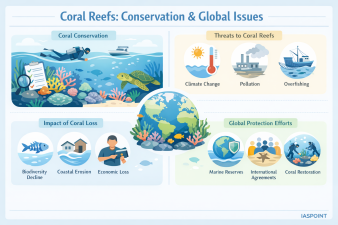
| Natural Stressors | El Niño events, Crown-of-Thorns Starfish (COTS) outbreaks, and tropical cyclones. |
| Anthropogenic | Overfishing, destructive fishing (cyanide/dynamite), and sedimentation from coastal runoff. |
| Chemical Change | Ocean Acidification: Increased CO2 lowers ocean pH, making it harder for corals to build calcium carbonate skeletons. |
| Trivia | Deep Sea Corals: Unlike shallow reefs, these live in cold, dark waters up to 6,000m deep and lack Zooxanthellae. |
| Symbiosis | Corals provide the algae with a protected environment and the compounds they need for photosynthesis. |
Modern Conservation Techniques
- Biorock Technology: Passing a low-voltage electrical current through seawater to accelerate mineral crystallization on structures, helping corals grow faster.
- Assisted Evolution: Selectively breeding heat-tolerant coral species to survive warming oceans.
- Marine Protected Areas (MPAs): Designated zones where human activity is restricted to allow ecosystem recovery.