
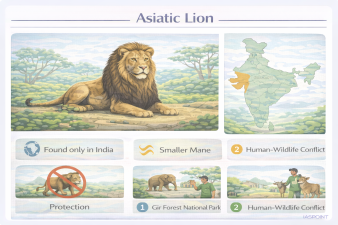
The Asiatic Lion (Panthera leo leo) is a flagship species of India and the only wild lion population existing outside of Africa. Traditionally known as the Indian Lion, it is now restricted to the Saurashtra peninsula of Gujarat. Historically, its range extended across Southwest Asia to eastern India, but intensive hunting and habitat loss during the 19th century pushed the species to the brink of extinction.
16th Asiatic Lion Census (2025)
The 2025 population estimation, conducted by the Gujarat Forest Department using the Block Count Method and Direct Beat Verification, showed a significant upward trend in both population and range.
| Parameter | 2020 Data | 2025 Data | Percentage Growth |
| Total Population | 674 | 891 | ~32.2% |
| Adult Males | 161 | 196 | ~21.7% |
| Adult Females | 260 | 330 | ~26.9% |
| Cubs/Sub-adults | 253 | 365 | ~44.3% |
| Geographic Distribution | 30,000 sq. km | 35,000 sq. km | ~17% |
Morphological and Behavioral Differences
For the UPSC exam, distinguishing the Asiatic Lion from the African Lion is a high-priority area.
- The Longitudinal Skin Fold: This is the most distinctive physical feature of the Asiatic Lion—a fold of skin running along its belly. This is rarely seen in African lions.
- Mane Characteristics: Male Asiatic lions have a shorter, sparser mane. This makes their ears always visible, unlike the African male whose thick mane often covers the ears.
- Elbow and Tail Tufts: The hair tufts on the elbows and the tip of the tail are generally more pronounced in Asiatic lions.
- Skull Structure: The Asiatic lion skull has bifurcated infraorbital foramina (two small holes for blood vessels/nerves), whereas the African lion typically has only one.
- Social Dynamics: Asiatic prides are smaller. Males are often solitary or live in small bachelor coalitions, associating with females primarily for mating or sharing a large kill.
Conservation Status and Legal Protection
- IUCN Red List: Endangered (Upgraded from ‘Critically Endangered’ in 2008).
- Wildlife (Protection) Act, 1972: Schedule I (Highest level of protection).
- CITES: Appendix I (Total ban on international trade).
Project Lion: The 360° Strategy
Launched in 2020, Project Lion aims to secure the future of the species through a multi-pronged approach under the Ministry of Environment, Forest and Climate Change (MoEFCC).
- Greater Gir Landscape: Managing the population across the entire 35,000 sq. km range, which now spans 11 districts including Junagadh, Amreli, Bhavnagar, and Gir Somnath.
- Barda Wildlife Sanctuary: Designated as the “second home” for lions within Gujarat to mitigate the risk of a single-point extinction (e.g., from an epidemic). Plans involve translocating 40 lions here.
- Disease Management: Establishing advanced viral research and diagnostic centers to prevent outbreaks like the Canine Distemper Virus (CDV) of 2018.
- Technological Integration: Extensive use of radio-collaring, GPS tracking, and “e-Eye” (electronic surveillance) to monitor lion movement and prevent human-animal conflict.
Key Habitats and Protected Areas
The Asiatic lion is no longer confined to the core Gir National Park. Its range is categorized into the following zones:
- Gir National Park & Sanctuary: The primary core habitat.
- Girnar Wildlife Sanctuary: A hilly terrain habitat near Junagadh city.
- Mitiyala Wildlife Sanctuary: Acts as a stepping stone for lions moving toward the coastal belts.
- Pania Wildlife Sanctuary: An extension of the Gir landscape.
- Satellite Populations: Lions have established permanent territories in coastal areas of Bhavnagar and the hilly tracts of Amreli, with nearly 37% of the population now residing outside protected areas.
Important Facts and Trivia for Prelims
- Endemic Status: The Asiatic Lion is the only lion subspecies found naturally in India.
- The “Maldharis”: These are local nomadic tribal herdsmen who live within the Gir forest. Their unique symbiotic relationship with lions is a classic example of community-led conservation.
- Threats: The “single population” risk remains the greatest threat. Other risks include drowning in open farm wells, electrocution by farm fences, and railway track accidents.
- Translocation Debate: While the Supreme Court (2013) directed translocation to Kuno National Park (MP), the current policy prioritizes the development of the Barda Sanctuary and the “Greater Gir” model within Gujarat.