
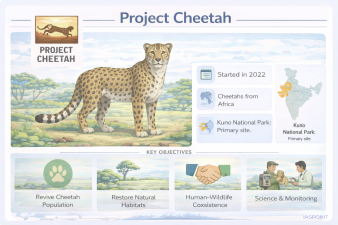
Project Cheetah is the world’s first intercontinental large wild carnivore translocation project. Launched on September 17, 2022, it aims to reintroduce the cheetah to India after the species was officially declared extinct in the country in 1952. The project is a multi-national collaboration involving India, Namibia, South Africa, and Botswana.
Historical Context and Extinction
The Cheetah (Acinonyx jubatus) is the only large carnivore to have gone extinct in Independent India.
- Year of Extinction: 1952.
- Last Sighting: The last three Asiatic cheetahs were shot in 1947 by Maharaja Ramanuj Pratap Singh Deo of Koriya (in present-day Chhattisgarh).
- Causes of Extinction: Over-hunting, habitat loss, and the decline of the prey base (specifically blackbuck and chinkara).
- Legal Status: Despite its extinction, the cheetah is listed under Schedule I of the Wild Life (Protection) Act, 1972.
Implementing Agencies and Regulatory Framework
The project is spearheaded by the Union Ministry of Environment, Forest and Climate Change (MoEFCC).
- Nodal Agency: National Tiger Conservation Authority (NTCA).
- Technical Support: Wildlife Institute of India (WII) and the Cheetah Conservation Fund (CCF).
- Monitoring: An 11-member Cheetah Steering Committee was established in 2023 to oversee the project following initial challenges and cub mortalities.
Selection of Habitats and Sites
The selection process involved assessing various sites based on prey density, habitat suitability, and human interference.
| Site Name | State | Current Status |
| Kuno National Park | Madhya Pradesh | Primary introduction site (selected for its grassland-forest mosaic). |
| Gandhi Sagar Sanctuary | Madhya Pradesh | Designated as the second home to reduce density pressure at Kuno. |
| Nauradehi Wildlife Sanctuary | Madhya Pradesh | Potential third site (part of the Veerangana Durgavati Tiger Reserve). |
| Shahgarh Bulge | Rajasthan | Shortlisted but currently faces challenges due to international border proximity. |
| Mukundra Hills Tiger Reserve | Rajasthan | Part of the proposed landscape corridor for dispersal. |
Translocation Phases and Global Sources
As of early 2026, India has successfully translocated 29 adult cheetahs from three African nations.
- Namibia (Sept 2022): 8 cheetahs (first batch) released by the Prime Minister at Kuno.
- South Africa (Feb 2023): 12 cheetahs translocated to augment the founder population.
- Botswana (Feb 2026): 9 cheetahs imported, making Botswana the third African partner.
- Key Fact: The translocated subspecies is the South East African Cheetah (Acinonyx jubatus jubatus), chosen due to its genetic similarity and availability compared to the critically endangered Asiatic Cheetah found only in Iran.
The Metapopulation and Landscape Management
The project has shifted from managing a single isolated population to a Metapopulation approach.
- Kuno-Gandhi Sagar Corridor: A proposed 17,000 sq. km inter-state landscape corridor covering 8 districts of Madhya Pradesh and 7 districts of Rajasthan.
- Natural Dispersal: In March 2026, India-born cubs (KP2 and KP3) demonstrated natural territorial behavior by moving 70 km from Kuno to the Baran district of Rajasthan.
- Objective: To establish a self-sustaining population of 60–70 cheetahs across this landscape over the next 15 years.
Comparative Analysis: African vs. Asiatic Cheetah
| Feature | African Cheetah | Asiatic Cheetah |
| Scientific Name | Acinonyx jubatus jubatus | Acinonyx jubatus venaticus |
| IUCN Status | Vulnerable | Critically Endangered |
| Current Habitat | Across Southern and Eastern Africa | Confined to small pockets in Iran |
| Physical Build | Slightly larger and sturdier | Smaller, slender, with a thicker coat |
| Prey Base | Diverse (Impala, Gazelle, etc.) | Limited (Chinkara, Wild Sheep) |
Conservation Significance and Socio-Economic Impact
Project Cheetah serves as a “Flagship Project” for the restoration of India’s neglected open forest and grassland ecosystems.
- Ecosystem Services: Reintroducing a top predator helps regulate herbivore populations and enhances biodiversity in semi-arid regions.
- Carbon Sinks: Restoration of grasslands contributes to India’s climate goals by acting as effective carbon sinks.
- Cheetah Mitras: Over 450 local volunteers (Cheetah Friends) are engaged in community awareness and human-wildlife conflict mitigation.
- Livelihood: Increased ecotourism in the Sheopur and Mandsaur regions of Madhya Pradesh.
Challenges and Critical Mortality Data
Despite successful births (over 25 cubs born on Indian soil), the project has faced significant hurdles.
- Mortality Causes: Adult deaths have occurred due to septicemia (linked to radio-collar moisture trap during monsoons), renal failure, and inter-specific fighting.
- Genetic Bottleneck: Managing a small founder population to ensure genetic health is a long-term challenge.
- Prey Density: Ensuring a consistent biomass of prey (Cheetal, Chinkara, Sambhar) across the expanded landscape.