
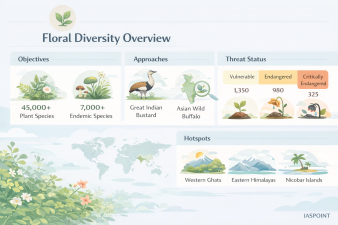
India is recognized as one of the 17 megadiverse countries in the world. With only 2.4% of the world’s land area, India contributes nearly 11% to 12% of the world’s recorded floral diversity.
- Global Ranking: India ranks 10th in the world and 4th in Asia in terms of plant diversity.
- Species Count: Approximately 54,733 plant species have been recorded in India to date, including angiosperms, gymnosperms, bryophytes, pteridophytes, algae, fungi, and lichens.
- Angiosperms (Flowering Plants): These constitute the largest group, with over 18,000 species, representing about 6-7% of the global total.
- Endemism: About 28% of Indian flora is endemic (found nowhere else). Major concentrations are in the Himalayas, Western Ghats, Northeast India, and the Andaman and Nicobar Islands.
Major Phytogeographic Regions and Diversity Hotspots
The floral distribution in India is primarily governed by the 10 Biogeographic Zones. Four of the world’s 36 Biodiversity Hotspots are located (fully or partially) in India, serving as high-density floral repositories.
| Region / Hotspot | Key Characteristics | Dominant Floral Species |
| Himalayas | Transition from tropical to alpine vegetation. | Oak, Rhododendron, Pine, Deodar, Brahma Kamal. |
| Western Ghats | High rainfall; tropical evergreen to montane ‘Shola’ forests. | Teak, Rosewood, Ironwood, Neelakurinji, Bamboo. |
| Indo-Burma (NE) | Highest species richness; epicenter of orchids. | Bamboo, Orchids, Dipterocarps, Indian Pitcher Plant. |
| Sundaland (Nicobar) | Unique insular and coastal ecosystems. | Mangroves (Rhizophora), Terminalia bialata. |
| Desert (Thar) | Xerophytic (drought-resistant) vegetation. | Cacti, Acacia (Khejri), Thorny shrubs, Ber. |
Classification of Indian Forests (Champion and Seth)
The floral composition is traditionally categorized into five major forest groups based on climate and altitude.
Moist Tropical Forests
- Tropical Wet Evergreen: Found in Western Ghats and NE India. Features multi-layered canopy. Examples: Mesua, White Cedar, Toon.
- Tropical Semi-Evergreen: Transitional zones between evergreen and deciduous. Examples: Laurel, Haldu, Arjun.
- Tropical Moist Deciduous: Most widespread in India (e.g., Eastern Ghats, Terai). Teak is the dominant species here.
Dry Tropical Forests
- Tropical Dry Deciduous: Covers vast parts of the Deccan Plateau and North India. Dominant species: Sal, Tendu, Bel, Khair.
- Tropical Thorn Forests: Arid regions of Rajasthan and Gujarat. Dominant species: Acacia, Babool, Wild Palm.
Montane Sub-Tropical and Temperate Forests
- Sub-Tropical Broad-Leaved: Found in the Nilgiris and Himalayas. Features Oak and Chestnut.
- Montane Temperate: High-altitude regions (1500m–3000m). Features Conifers like Deodar, Spruce, and Silver Fir.
Alpine Forests
- Occur above 3000m up to the snow line. Dominated by Rhododendrons, Birch (Silver Birch/Bhojpatra), and Junipers.
Conservation Status and Legal Protection
The protection of floral diversity is governed by domestic laws and international red lists to prevent extinction from over-exploitation and habitat loss.
IUCN Red List Categories for Indian Flora
The International Union for Conservation of Nature (IUCN) assesses species based on extinction risk.
- Critically Endangered (CR): Species like the Red-crowned Roofed Turtle’s habitat flora or specific medicinal herbs like Aconitum ferox.
- Endangered (EN): Includes species like the Asiatic Lion’s habitat flora and specialized orchids of the Northeast.
- Vulnerable (VU): Species facing high risk in the wild, often due to commercial harvesting.
Wildlife (Protection) Act (WPA), 1972: Schedule VI
Specific plants are protected under Schedule VI of the WPA 1972. Cultivation, collection, or possession of these plants without a license is prohibited.
- Beddomes’ Cycad (Cycas beddomei)
- Blue Vanda (Vanda coerulea)
- Kuth (Saussurea lappa)
- Ladies Slipper Orchids (Paphiopedilum spp.)
- Pitcher Plant (Nepenthes khasiana)
- Red Vanda (Renanthera imschootiana)
Economic and Cultural Significance (Trivia for Prelims)
- Neelakurinji (Strobilanthes kunthiana): Famous for blooming once every 12 years in the Western Ghats (Munnar).
- Brahma Kamal (Saussurea obvallata): The state flower of Uttarakhand, found at very high altitudes (3000m+).
- Mangroves: India has about 3% of the world’s mangrove vegetation. The Sundarbans is the largest contiguous mangrove forest globally.
- Medicinal Heritage: India is home to nearly 8,000 species of medicinal plants used in Ayurveda, Unani, and Siddha systems.