
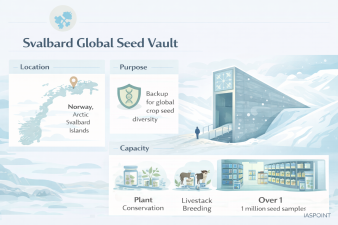
The Svalbard Global Seed Vault (SGSV), often termed the “Doomsday Vault,” is a secure, long-term seed storage facility designed to serve as a final backup for the world’s crop diversity. It is intended to safeguard seeds against accidental loss of diversity in traditional gene banks due to mismanagement, equipment failure, funding cuts, natural disasters, or war.
- Location: Located on the Norwegian island of Spitsbergen in the remote Arctic Svalbard archipelago.
- Geographical Advantage: Built 130 meters above sea level to remain safe from sea-level rise; situated 120 meters deep inside a sandstone mountain to utilize the natural permafrost for cooling.
- Current Status (April 2026): As of the latest deposit in February 2026, the vault holds approximately 1,387,038 seed samples from nearly every country in the world.
Management and Legal Framework
The vault operates under a unique international partnership and legal structure that ensures seeds remain the property of the depositors.
- Tripartite Agreement: Managed by the Norwegian Government, the Crop Trust (an international NGO), and the Nordic Genetic Resource Center (NordGen).
- The “Black Box” Principle: Seeds are stored under “black box” conditions. This means the depositor gene bank maintains ownership; only they can open or withdraw their seed boxes.
- International Treaty Alignment: The vault’s operations are recognized as a key element of the funding strategy of the International Treaty on Plant Genetic Resources for Food and Agriculture (ITPGRFA).
Technical Specifications
The facility is engineered to last for centuries with minimal human intervention.
| Feature | Specification / Detail |
| Storage Temperature | Maintained at a constant -18°C (0°F). |
| Storage Capacity | Can house up to 4.5 million seed samples (approx. 2.5 billion individual seeds). |
| Security | Highly resistant to volcanic activity, earthquakes, radiation, and rising sea levels. |
| Cooling Mechanism | While permafrost provides a natural “fail-safe” of -3°C to -4°C, local coal-powered electricity provides additional cooling to reach the -18°C standard. |
India’s Participation and Contributions
India has been a significant contributor to the Svalbard Global Seed Vault, viewing it as a critical backup for its own national food security.
- Depositor Agency: The National Bureau of Plant Genetic Resources (NBPGR), under ICAR, manages India’s deposits.
- Seed Varieties: India has deposited duplicates of major staples, including several thousand accessions of Rice, Pearl Millet (Bajra), Pigeon Pea (Arhar), and Sorghum.
- Regional Revival: India’s successful “millet revival” programs are documented in the Arctic World Archive (a neighboring digital data facility), highlighting India’s global leadership in climate-resilient agriculture.
Recent 2026 Milestones (UPSC Trivia)
- First Olive Deposit: In February 2026, the vault received its first-ever deposit of Olive seeds (50 cultivated varieties and wild oleasters) through a European research project.
- New Member Countries: Guatemala and Niger deposited seeds for the first time in early 2026, expanding the vault’s representation of Mesoamerican and Sahelian biodiversity.
- The ICARDA Precedent: The first-ever withdrawal from the vault was made by the International Center for Agricultural Research in the Dry Areas (ICARDA) in 2015 after its gene bank in Aleppo, Syria, was compromised by war. This proved the vault’s “insurance policy” utility.
Key Comparison for Environment GS
| Feature | Svalbard Global Seed Vault | India’s Chang La Vault (Ladakh) |
| Altitude | ~130m above sea level | ~17,300 feet (highest in the world) |
| Primary Goal | Global backup for all gene banks. | Regional backup and research for Indian high-altitude flora. |
| Cooling | Artificial refrigeration + Permafrost. | Natural high-altitude sub-zero temperatures (low energy). |
| Ownership | International (Black Box storage). | National (DRDO/DIHAR). |