
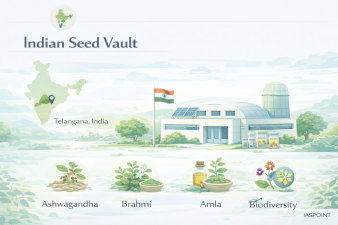
The Indian Seed Vault is a secure, long-term seed storage facility designed to preserve the genetic diversity of Indian plant species. Functioning as a “genetic insurance policy,” it protects seeds against natural disasters, climate change, and anthropogenic threats. It is the world’s second-largest permafrost seed vault, modeled after the Svalbard Global Seed Vault in Norway.
Geographic and Structural Details
- Location: Chang La, Ladakh, in the Himalayas.
- Altitude: Situated at approximately 17,300 feet (5,300 meters) above sea level.
- Selection of Site: The high-altitude permafrost environment provides natural sub-zero temperatures, reducing the dependence on continuous electrical power for cooling. The low humidity and low oxygen levels at this altitude further enhance seed longevity.
- Institutional Ownership: It was established and is maintained by the Defence Institute of High Altitude Research (DIHAR), a laboratory of the Defence Research and Development Organisation (DRDO), in collaboration with the National Bureau of Plant Genetic Resources (NBPGR).
Core Objectives and Functions
The vault serves as a back-up for active germplasm collections stored at other research centers across India.
- Ex-situ Conservation: Preservation of components of biological diversity outside their natural habitats.
- Safety Duplication: Storing duplicates of seeds currently held in the National Gene Bank in New Delhi to prevent total loss in case of a catastrophe.
- Cryopreservation: While the vault uses natural cold, it complements the NBPGR’s cryopreservation (storage in liquid nitrogen at -196°C) efforts for long-term survival.
Technical Specifications of Storage
The efficacy of the seed vault relies on precise environmental and packaging standards.
| Feature | Specification |
| Storage Temperature | Maintained at approximately -18°C to -20°C. |
| Packaging | Seeds are dried to low moisture content (around 5-7%) and sealed in three-layered foil pouches. |
| Power Source | Primarily utilizes the natural ambient temperature of the permafrost; secondary backup power is available for monitoring. |
| Access Control | Highly restricted; the vault remains sealed and is opened only for deposit or monitoring of seed viability. |
Biodiversity and Collections
The vault houses a wide array of seeds, prioritizing those of high economic and ecological value.
- Agricultural Crops: Major varieties of rice, wheat, barley, and millets.
- Medicinal Plants: Rare and endangered species from the Himalayan region, such as Aconitum and Rheum species.
- Abiotic Stress Tolerant Varieties: Seeds of plants that can withstand extreme cold, salinity, or drought, which are critical for future climate change adaptation.
- Current Capacity: The vault has the capacity to store over 5,000 accessions (specific seed samples), with thousands already deposited by NBPGR and other ICAR (Indian Council of Agricultural Research) institutions.
Regulatory and International Context
- Protection of Plant Varieties and Farmers’ Rights (PPV&FR) Act, 2001: This act provides the legal framework for the registration and protection of plant varieties, supporting the mission of the seed vault.
- Svalbard Global Seed Vault (Norway): While India has its own vault, it also occasionally sends duplicates of its core collections to Svalbard as a global level of redundancy.
- International Treaty on Plant Genetic Resources for Food and Agriculture (ITPGRFA): India is a signatory, committing to the conservation and sustainable use of plant genetic resources.
Key Trivia for UPSC
- The Chang La Mission: The vault was inaugurated in 2010.
- DIHAR’s Role: Beyond the seed vault, DIHAR works on “Cold Desert Agro-Animal Technologies” to ensure food security for troops stationed in high-altitude sectors like Siachen.
- Permafrost: Defined as ground that remains completely frozen (0°C or colder) for at least two years straight. The Indian Seed Vault is one of the few facilities globally to leverage this for bio-banking.