
Agroforestry is a collective name for land-use systems and technologies where woody perennials (trees, shrubs, palms, bamboos, etc.) are deliberately used on the same land-management units as agricultural crops and/or animals. In India, it is viewed as a critical strategy to achieve the target of 33% forest cover and to fulfill the Nationally Determined Contributions (NDCs) of creating an additional carbon sink of 2.5 to 3 billion tonnes of CO2 equivalent by 2030.
Core Classification of Agroforestry Systems
Agroforestry is categorized based on the combination of components integrated into the land unit.
Structural Classification
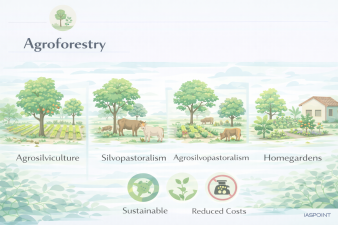
- Agrisilvicultural Systems: Crops + Trees (e.g., Poplar or Eucalyptus trees with wheat or paddy).
- Silvopastoral Systems: Trees + Pasture/Livestock (e.g., Protein bank trees like Leucaena leucocephala in grazing lands).
- Agrosilvopastoral Systems: Crops + Trees + Livestock (e.g., Home gardens or woody hedgerows for browse, mulch, and green manure).
- Other Systems:
- Apiculture with Trees: Integration of honey bees with flowering tree species.
- Aquaforestry: Trees lining fish ponds (leaves serve as fish fodder).
- Sericulture: Integration of silkworm host trees (like Mulberry) with agriculture.
National Policy Framework
India was the first country in the world to adopt a comprehensive policy on agroforestry.
National Agroforestry Policy (2014)
- Objective: To improve productivity, provide employment, and ensure environmental security.
- Key Provisions: * Simplified the restrictive regulations on harvesting and transportation of trees grown on private farms (Transit Permits).
- Integration of agroforestry with the National Mission for Sustainable Agriculture (NMSA).
- Focuses on providing “Insurance” and “Credit” to farmers adopting tree-based farming.
Sub-Mission on Agroforestry (SMAF)
- Launched in 2016-17, it provides financial assistance for nursery development, peripheral and boundary plantations, and low-density plantations on farmlands.
- In 2022-23, it was subsumed under the Rashtriya Krishi Vikas Yojana (RKVY) as “Agroforestry” to provide more flexibility to states.
Economic and Ecological Benefits
- Carbon Sequestration: Trees in agroforestry systems sequester significantly more carbon than monoculture crop systems.
- Soil Health: Nitrogen-fixing trees (e.g., Gliricidia sepium) enhance soil fertility; deep roots prevent soil erosion and improve water infiltration.
- Micro-climate Regulation: Tree canopies reduce soil temperature and wind speed, protecting sensitive crops from heatwaves and desiccation.
- Income Diversification: Provides timber, fuelwood, fodder, and fruits, acting as a “buffer” during crop failures (climatic risk mitigation).
Prominent Agroforestry Species in India
| Species Name | Region/Zone | Utility |
|---|---|---|
| Khejri (Prosopis cineraria) | Arid/Rajasthan | Known as the “King of the Desert”; provides fodder and improves soil nitrogen. |
| Poplar (Populus deltoides) | Indo-Gangetic Plains | Fast-growing; used for plywood and matchstick industries. |
| Eucalyptus | Pan-India | High biomass production; widely used for pulpwood. |
| Melia dubia (Malabar Neem) | South India | High timber value; used in the plywood industry. |
| Subabul (Leucaena leucocephala) | Tropical India | Excellent fodder and fuel-wood; high nitrogen fixation. |
Key Concepts for UPSC Prelims
- Alley Cropping: Planting food crops within “alleys” formed by hedgerows of trees or shrubs that are regularly pruned to prevent shading.
- Taungya System: A historical system where forest plantations are established by allowing farmers to grow seasonal crops between rows of planted trees.
- Boundary Plantation: Planting trees along the borders of the field to serve as a windbreak and provide supplementary income without occupying core cropping area.
- Windbreaks and Shelterbelts: Linear strips of trees planted to protect leeward areas from strong winds and sand drift (crucial in the Thar Desert).
Critical Challenges
- Long Gestation Period: Trees take years to mature, which discourages small and marginal farmers with immediate cash flow needs.
- Transit Rules: Despite the 2014 policy, many states still have cumbersome regulations for cutting and transporting timber from private land.
- Market Linkages: Lack of organized markets for agroforestry produce compared to MSP-supported cereal crops.
- Allelopathy: Some trees (like Eucalyptus) release chemicals that may inhibit the growth of certain understory crops.
Trivia for Prelims
- Global Center for Agroforestry: The World Agroforestry Centre (ICRAF) is headquartered in Nairobi, Kenya, but has a significant presence in South Asia (New Delhi).
- Bishnoi Movement: Historically linked to the protection of the Khejri tree, showcasing the deep-rooted cultural importance of agroforestry in India.
- Green India Mission (GIM): One of the eight missions under the National Action Plan on Climate Change (NAPCC), which identifies agroforestry as a key component for increasing forest cover.