
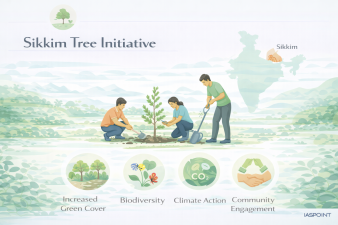
Sikkim, often hailed as the “Greenest State of India,” has consistently pioneered environmental conservation through community-centric policies. The Sikkim Tree Initiative, primarily encapsulated by the “Mero Rukh Mero Santati” (My Tree, My Child) scheme launched in 2023, represents a paradigm shift from traditional afforestation to “emotional forestry.”
Key Program: Mero Rukh Mero Santati (MRMS)
Launched by the Government of Sikkim, this initiative is a unique green intervention designed to commemorate childbirth by planting trees.
- Core Objective: To plant 100 trees for every newborn baby in Sikkim.
- Philosophy: Creating an “environmental legacy” where the growth of a child is symbolically and ecologically linked to the growth of a mini-forest.
- Implementation Agency: Forest and Environment Department, Government of Sikkim, in collaboration with the Health Department.
- Operational Mechanism: * Parents register through a digital platform or via ASHA/Anganwadi workers upon the birth of a child.
- The Forest Department provides saplings and technical support for free.
- Plantation takes place during Santati Saptah (Children’s Week), observed annually in the first week of July.
Ecological and Carbon Sequestration Potential
The initiative is not merely symbolic but carries significant environmental weightage aimed at making Sikkim a carbon-neutral leader.
- Carbon Offset: It is estimated that 100 trees per child can sequester approximately 2.2 metric tons of CO2 annually.
- Per Capita Impact: This sequestration capacity comfortably offsets the average Indian per capita carbon emission (approx. 1.9 metric tons).
- Biodiversity Restoration: Parents can choose from various indigenous species, ensuring the preservation of local flora such as Rhododendrons and local fruit-bearing trees.
Institutional Landscape of Sikkim’s Forestry
Sikkim’s commitment to trees is rooted in a long history of legislative and social interventions.
| Initiative | Year | Key Feature |
| Smriti Van | 1999 | Creating “Memorial Forests” where people plant trees in memory of departed souls. |
| State Green Mission | 2006 | Mass plantation along roadsides and vacant lands to make Sikkim a “Garden State.” |
| Ten Minutes to Earth | 2009 | A state-wide annual event where every citizen plants a sapling for 10 minutes on June 25. |
| Paryavaran Mahotsav | Annual | A week-long environmental festival focused on mass awareness and cleanliness drives. |
| Plastic Ban | 1998 | Sikkim was the first Indian state to ban plastic carry bags. |
Sikkim’s Forest Statistics for UPSC Prelims
Aspirants should note the specific geographical and ecological data of Sikkim as per the latest reports.
- Forest Cover: Approximately 47% of the state’s total geographical area.
- Recorded Forest Area (RFA): Covers about 82% of the state’s land.
- State Tree: Rhododendron niveum.
- Key Protected Area: Khangchendzonga National Park (a UNESCO World Heritage Site under the ‘Mixed’ category).
- Special Status: India’s first 100% Organic State (declared in 2016), which significantly reduces chemical runoff into forest ecosystems.
Governance and Legal Framework
The success of tree initiatives in Sikkim is supported by stringent local laws and constitutional provisions.
- Article 371F: Provides special provisions for Sikkim, allowing the state to maintain its unique social and ecological identity.
- Ban on Grazing: Sikkim implemented a strict ban on open grazing in forest areas to allow natural regeneration of trees.
- Green Cess: The state levies a “Green Cess” on vehicles and industries to fund environmental conservation projects.
Sikkim’s Environmental Trivia for Competitive Exams
- First in the World: Sikkim was awarded the UN Future Policy Gold Award in 2018 for its transition to 100% organic farming, which acts as a foundational support for its forestry initiatives.
- Sacred Groves: The state protects numerous “Sacred Groves” (Deoras) managed by local communities, blending religious belief with conservation.
- Carbon Sink: Due to its high forest cover per capita, Sikkim acts as a net carbon sink for the Eastern Himalayan region.