
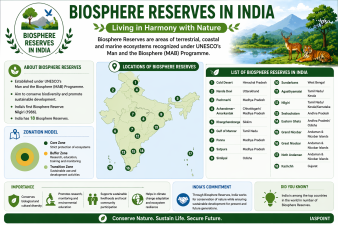
Biosphere Reserves (BRs) are designated areas of terrestrial and coastal ecosystems that promote solutions to reconcile the conservation of biodiversity with its sustainable use. These are not just “protected areas” but “living laboratories” where human communities and nature co-exist.
Conceptual Framework and Zonation
Biosphere Reserves are structured into three distinct zones to balance conservation and human activity:
- Core Area: A strictly protected zone that contributes to the conservation of landscapes, ecosystems, species, and genetic variation. No human activity is allowed except for monitoring and non-destructive research.
- Buffer Zone: Surrounds the core area. Activities are organized so they do not hinder the conservation objectives of the core but rather help protect it. This includes scientific research, monitoring, training, and education.
- Transition Area (Area of Cooperation): The outermost part where local communities, management agencies, scientists, and other stakeholders work together to manage and sustainably develop the area’s resources.
Administrative and Financial Governance
- Nodal Agency: The Ministry of Environment, Forest and Climate Change (MoEFCC) implements the Biosphere Reserve scheme in India.
- Financial Assistance: The Central Government provides financial assistance for the management of these reserves. For North-Eastern and Himalayan states, the funding ratio is 90:10, while for other states, it is 60:40.
- Legal Status: Unlike National Parks or Wildlife Sanctuaries, “Biosphere Reserve” as a category is not defined under the Wildlife Protection Act, 1972. However, the core areas are usually notified as National Parks or Sanctuaries under the Act.
UNESCO Man and the Biosphere (MAB) Programme
The MAB programme, launched in 1971, is an intergovernmental scientific program that aims to establish a scientific basis for the improvement of relationships between people and their environments.
- World Network of Biosphere Reserves (WNBR): Out of 18 Biosphere Reserves in India, 12 are recognized under the UNESCO MAB World Network.
- Latest Inclusion: Panna Biosphere Reserve (Madhya Pradesh) was the 12th reserve to be included in the MAB list in 2020.
Comprehensive List of Biosphere Reserves in India
| Name | Year (Est.) | State(s) | Key Fauna | UNESCO MAB Status |
| Nilgiri | 1986 | TN, KL, KA | Nilgiri Tahr, Lion-tailed Macaque | Included (2000) |
| Nanda Devi | 1988 | Uttarakhand | Snow Leopard, Himalayan Black Bear | Included (2004) |
| Nokrek | 1988 | Meghalaya | Red Panda, Hoolock Gibbon | Included (2009) |
| Gulf of Mannar | 1989 | Tamil Nadu | Dugong (Sea Cow) | Included (2001) |
| Sundarbans | 1989 | West Bengal | Royal Bengal Tiger | Included (2001) |
| Manas | 1989 | Assam | Pygmy Hog, Golden Langur | Not Included |
| Great Nicobar | 1989 | A&N Islands | Saltwater Crocodile | Included (2013) |
| Simlipal | 1994 | Odisha | Gaur, Royal Bengal Tiger | Included (2009) |
| Dibru-Saikhowa | 1997 | Assam | White-winged Wood Duck | Not Included |
| Dihang-Dibang | 1998 | Arunachal | Mishmi Takin, Musk Deer | Not Included |
| Pachmarhi | 1999 | MP | Giant Squirrel, Flying Squirrel | Included (2009) |
| Khangchendzonga | 2000 | Sikkim | Snow Leopard, Red Panda | Included (2018) |
| Agasthyamala | 2001 | KL, TN | Nilgiri Tahr, Elephant | Included (2016) |
| Achanakmar-Amarkantak | 2005 | MP, Chhattisgarh | Four-horned Antelope | Included (2012) |
| Kachchh (Great Rann) | 2008 | Gujarat | Indian Wild Ass | Not Included |
| Cold Desert | 2009 | Himachal | Snow Leopard | Not Included |
| Seshachalam | 2010 | Andhra Pradesh | Slender Loris | Not Included |
| Panna | 2011 | MP | Tiger, Chinkara, Sambhar | Included (2020) |
Vital Statistics and Prelims Trivia
Geographic Extremes
- First Biosphere Reserve: Nilgiri Biosphere Reserve (1986).
- Largest Biosphere Reserve: Great Rann of Kachchh, Gujarat.
- Smallest Biosphere Reserve: Dibru-Saikhowa, Assam.
Ecological and Cultural Facts
- Khangchendzonga: This reserve is unique as it includes Khangchendzonga National Park, which is India’s only “Mixed” World Heritage Site (recognized for both natural and cultural significance).
- Sundarbans: Home to the world’s largest mangrove forest and the only mangrove habitat for tigers.
- Nilgiri: Encompasses several protected areas including Mudumalai, Mukurthi, Wayanad, Bandipur, Nagarhole, and Silent Valley.
- Gulf of Mannar: The first Marine Biosphere Reserve in South and South-East Asia.
- Nokrek: Located on the Tura Range; it is a vital habitat for citrus gene pools (Citrus indica).
Tribal Populations
Many Biosphere Reserves are home to specific indigenous tribes:
- Nilgiri: Todas, Kotas, Irullas, and Kurumbas.
- Great Nicobar: Shompens and Nicobarese.
- Agasthyamala: Kani tribes.
- Simlipal: Santhals and Mankidias.
- Panna: Gond, Khairuas, and Yadavas.