
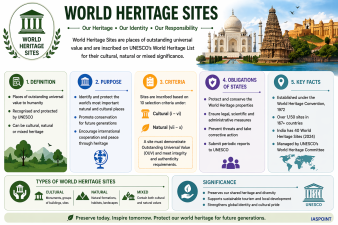
UNESCO World Heritage Sites are properties recognized for their Outstanding Universal Value (OUV) under the 1972 Convention Concerning the Protection of the World Cultural and Natural Heritage. India ratified the convention on November 14, 1977, and currently ranks 6th globally in the total number of recognized sites.
- Operational Guidelines: To be included, a site must meet at least one of the ten selection criteria (six cultural and four natural).
- Advisory Bodies: International Council on Monuments and Sites (ICOMOS) for cultural sites and the International Union for Conservation of Nature (IUCN) for natural sites.
- Tentative List: A mandatory prerequisite; a site must be on this list for at least one year before formal nomination. As of early 2026, India has 62 sites on its Tentative List.
Statistical Overview (As of April 2026)
India currently hosts a total of 44 World Heritage Sites, reflecting its civilizational depth and biological diversity.
| Category | Number of Sites | Description |
| Cultural | 36 | Man-made structures, archaeological sites, and urban landscapes. |
| Natural | 7 | Ecologically significant areas, national parks, and biodiversity hotspots. |
| Mixed | 1 | Khangchendzonga National Park (Sikkim); recognized for both values. |
| Total | 44 | Total officially inscribed sites. |
Recent Inscriptions (2024–2025)
India has seen significant additions in the last two years, expanding the representation of its regional and military history.
- Moidams (Assam) – 2024: The mound-burial system of the Ahom dynasty; the first cultural site from Northeast India to receive the tag.
- Maratha Military Landscapes (2025): A serial nomination of 12 forts (including Raigad, Shivneri, and Pratapgad) showcasing the strategic military architecture of the Maratha Empire under Chhatrapati Shivaji Maharaj.
Major Cultural Heritage Sites
Cultural sites comprise the largest portion of India’s list, spanning from the prehistoric era to modern architecture.
Ancient and Prehistoric
- Bhimbetka Rock Shelters (MP): Evidence of human life from the Mesolithic period; famous for prehistoric cave paintings.
- Dholavira (Gujarat): A premier Harappan city showcasing advanced water management and urban planning.
Temple Architecture
- Sun Temple, Konark (Odisha): 13th-century Kalinga architecture built by Narasimhadeva I; shaped like a giant celestial chariot.
- Sacred Ensembles of the Hoysala (Karnataka): Includes the 12th-13th century temples of Belur, Halebidu, and Somanathapura.
- Ramappa Temple (Telangana): A 13th-century Kakatiya marvel known for its “floating bricks” and intricate carvings.
Indo-Islamic and Mughal Architecture
- Taj Mahal & Agra Fort (UP): High points of Mughal artistic and defensive architecture.
- Fatehpur Sikri (UP): The short-lived capital of Akbar, featuring a blend of Persian and Indian styles.
Natural Heritage Sites
These sites are frequent focus areas for environment-related questions in UPSC Prelims.
| Site Name | State | Key Significance |
| Kaziranga National Park | Assam | Largest population of One-horned Rhinos; Brahmaputra floodplains. |
| Manas Wildlife Sanctuary | Assam | Project Tiger reserve and Project Elephant site; high endemism. |
| Keoladeo National Park | Rajasthan | Man-made wetland; critical wintering ground for the Siberian Crane. |
| Great Himalayan NP | Himachal Pradesh | High-altitude alpine meadows and glacial headwaters of Beas and Indus. |
| Western Ghats | Multi-state | A “Hottest Hotspot” of biodiversity; serial nomination of 39 sub-clusters. |
| Sundarbans National Park | West Bengal | Largest estuarine mangrove forest in the world; home to the Royal Bengal Tiger. |
Mixed World Heritage Site
Khangchendzonga National Park (Sikkim) remains India’s only Mixed site (inscribed 2016).
- Cultural: Home to sacred sites associated with the indigenous Lepcha and Buddhist traditions (Beyul).
- Natural: Contains the world’s third-highest peak, Mt. Kanchenjunga, and spans diverse eco-zones from sub-tropical to alpine.
Important Trivia for UPSC
- City with most sites: Delhi and Mumbai each host 3 World Heritage Sites.
- First Sites (1983): Ajanta Caves, Ellora Caves, Agra Fort, and the Taj Mahal.
- Tentative List Additions (2025-26): Recent entries include the Kanger Valley National Park, Chausath Yogini Temples, and the Ashokan Edict Sites along Mauryan routes.
- State with maximum sites: Maharashtra currently leads the count with 6 sites (following the Maratha Forts addition).