
Agriculture is the sector most sensitive to climate variability, as it depends directly on temperature, precipitation, and CO2 concentrations. For India, where nearly 51% of the net sown area is rainfed and agriculture employs about 45-50% of the workforce, climate change is a direct threat to national food security and the rural economy.
Direct Impacts on Crop Productivity
Climate change alters the physiological processes of plants, leading to significant yield gaps in staple crops.
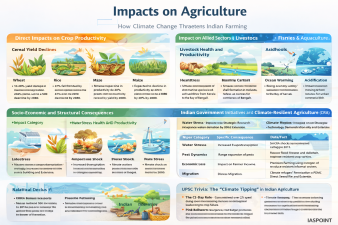
Cereal Yield Declines
- Wheat: Highly sensitive to “terminal heat stress” during the grain-filling stage. Projections suggest a 10-20% yield drop by 2025-2030 and up to a 50% decline by 2080 if temperatures rise by 3-4°C.
- Rice: While increased CO2 can theoretically boost growth (CO2 fertilization), rising night-time temperatures increase plant respiration, which reduces net yield. Rainfed rice yields in India could fall by up to 47% by 2080.
- Maize: Expected to see a 23% decline in productivity by 2080 due to heat and water stress.
Nutritional Security
Elevated CO2 levels lead to “hidden hunger” by reducing the concentration of essential micronutrients in crops.
- Nutrient Dilution: Studies indicate a 5-10% reduction in protein, iron, and zinc content in rice and wheat under high CO2 scenarios.
Impact on Allied Sectors: Livestock and Fisheries
Agriculture in India is an integrated system; climate shocks to allied sectors multiply rural distress.
Livestock Health and Productivity
- Heat Stress: High temperatures reduce feed intake and metabolic efficiency in cattle, leading to a 10-25% drop in milk yield.
- Water Scarcity: Reduced availability of fodder and water increases livestock mortality and reduces reproductive rates.
Fisheries and Aquaculture
- Ocean Warming: Shifting of marine species toward the poles (meridional shift). In India, oil sardines have been observed moving from the Kerala coast to the cooler waters of the Bay of Bengal.
- Acidification: Rising ocean acidity hinders the shell-formation process in mollusks and affects coral reef ecosystems, which serve as nurseries for many commercial fish.
Socio-Economic and Structural Consequences
| Impact Category | Specific Consequence | Data/Fact |
| Water Stress | Increased Evapotranspiration | 1°C rise increases irrigation water demand by 10% |
| Pest Dynamics | Range expansion of pests | Warmer winters allow pests like the Fall Armyworm to survive |
| Economic Loss | Impact on Farmer Income | Climate shocks can reduce farm income by 15-25% |
| Migration | Distress Migration | “Climate refugees” moving from rural to urban informal sectors |
Indian Government Initiatives and Climate-Resilient Agriculture (CRA)
The government has shifted focus from “Production-Centric” to “Resilience-Centric” agriculture through various missions.
National Innovations in Climate Resilient Agriculture (NICRA)
Launched by ICAR in 2011, it focuses on four modules: Strategic Research, Technology Demonstration, Capacity Building, and Extension. It has established “Climate Resilient Villages” across 448 districts.
Key Technologies and Strategies
- Smart Seeds: Development of flood-tolerant (e.g., Swarna-Sub1 rice) and drought-resistant crop varieties.
- Conservation Agriculture: Zero-tillage farming to reduce soil erosion and improve carbon sequestration.
- Precision Farming: Use of Drip Irrigation and Fertigation under the ‘Per Drop More Crop’ (PDMC) scheme.
- Direct Seeded Rice (DSR): A technique that saves water and reduces methane emissions compared to traditional transplanting.
UPSC Trivia: The “Climate Tipping” in Indian Agriculture
- The 21-Day Rule: In Indian agriculture, a dry spell of more than 21 days during the monsoon is considered a “meteorological drought” that can lead to total crop failure in rainfed areas.
- Pink Bollworm: This pest has seen a resurgence in BT-Cotton belts due to shifting temperature windows, highlighting the limits of current GM technologies against climate shifts.
- Zero Budget Natural Farming (ZBNF): Now promoted as ‘Bhartiya Prakritik Krishi Paddhati’, it is seen as a way to enhance soil moisture retention and reduce farmer dependence on high-cost chemical inputs, making them more resilient to climate-induced financial shocks.