
The implementation of Sustainable Development Goals (SDGs) in India is anchored in the principle of “Sabka Saath, Sabka Vikas, Sabka Vishwas, Sabka Prayas.” India has transitioned from global commitments to localized action through a structured institutional framework.
Nodal Agencies and Monitoring Tools
- NITI Aayog: The premier policy think-tank of India is the nodal agency for SDGs. it is responsible for the adoption, monitoring, and “localization” of SDGs across States and Union Territories (UTs).
- MoSPI (Ministry of Statistics and Programme Implementation): Developed the National Indicator Framework (NIF), which consists of 284 national indicators (as of 2025) to track progress objectively.
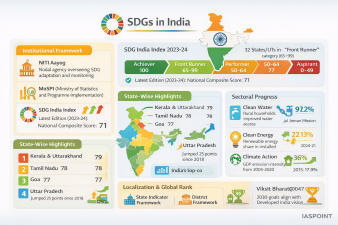
- SDG India Index: Launched by NITI Aayog, this is the primary tool for measuring progress. The latest SDG India Index 2023-24 (Edition 4.0) shows a national composite score of 71, a significant rise from 66 in 2020-21 and 57 in 2018.
SDG India Index 2023-24: Performance Classification
India utilizes a four-tier classification system to rank States and UTs based on their composite scores (0–100).
| Category | Score Range | Status in 2023-24 |
| Achiever | 100 | Target achieved. |
| Front Runner | 65–99 | 32 States/UTs (Major shift from previous years). |
| Performer | 50–64 | Decreasing number of states (indicating upward mobility). |
| Aspirant | 0–49 | Zero states currently in this category. |
State-wise Performance Highlights
- Top Performers: Kerala and Uttarakhand joint-ranked 1st with a score of 79, followed by Tamil Nadu (78) and Goa (77).
- Fastest Mover: Uttar Pradesh has shown the most significant improvement, jumping 25 points since 2018 to enter the “Front Runner” category.
- Goal-specific Achievers: Many states have achieved a perfect score of 100 in SDG 7 (Affordable and Clean Energy) and SDG 12 (Responsible Consumption and Production).
Sectoral Progress and Key Data Points (2025 Updates)
India’s progress is reflected in the SDG-NIF Progress Report 2025 and the Voluntary National Review (VNR) 2025.
Social and Economic Indicators
- Poverty Reduction (SDG 1): Multi-dimensional poverty declined from 24.85% (2015-16) to 14.96% (2019-21). Social protection coverage (pension, insurance, etc.) expanded from 22% in 2016 to 64.3% in 2025.
- Zero Hunger (SDG 2): Agricultural productivity (GVA per worker) increased to ₹94,110 in 2024-25 from ₹61,247 in 2015-16.
- Gender Equality (SDG 5): The female-to-male Labour Force Participation Rate (LFPR) improved to 0.54 in 2023-24. Exclusive Women Self-Help Groups (SHGs) in bank-linked networks reached 97.04%.
Environmental and Infrastructure Indicators
- Clean Water (SDG 6): Rural access to improved drinking water reached 99.62% in 2024-25, largely driven by the Jal Jeevan Mission.
- Clean Energy (SDG 7): Renewable energy’s share in total installed capacity rose to 22.13% (2024-25). Per capita renewable capacity grew to 156.31 watts.
- Climate Action (SDG 13): India reduced its GDP emission intensity by 36% between 2005 and 2020, meeting its initial COP21 targets ahead of schedule.
- Waste Management (SDG 11 & 12): The percentage of waste processed increased drastically from 17.97% (2015-16) to 80.7% in 2024-25.
Localization of SDGs: The Bottom-Up Approach
India’s unique model of “SDG Localization” ensures that the global goals are translated into local actions.
- State Indicator Framework (SIF): States develop their own indicators aligned with the NIF but tailored to local priorities.
- District Indicator Framework (DIF): Districts are monitored to foster competitive federalism at the grassroots.
- Panchayat Level: Integrating SDGs into Gram Panchayat Development Plans (GPDPs) ensures that the last mile is covered.
Important Global Rankings & Trivia
- Global SDG Index 2025: India ranked 99th out of 167 countries, entering the top 100 for the first time with a score of 67.
- VNR 2025: India presented its third Voluntary National Review at the UN High-Level Political Forum (HLPF), highlighting the role of Digital Public Infrastructure (DPI) in achieving SDGs.
- Synergy with Viksit Bharat@2047: The 2030 Agenda is officially viewed as a milestone toward the longer-term vision of making India a developed nation by 2047.