

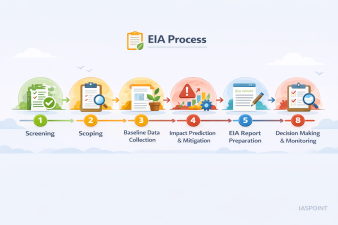
The EIA process is a systematic, multi-step procedure used to evaluate the environmental consequences of a proposed project before decisions are made. In India, this process is legally governed by the EIA Notification, 2006 (and its subsequent amendments) under the Environment (Protection) Act, 1986. It ensures that environmental concerns are integrated into the project planning cycle.
The Sequential Stages of the EIA Process
The Indian EIA process consists of eight well-defined stages. While Category A projects undergo all stages at the Central level, Category B projects are managed at the State level.
1. Screening
Screening is the initial stage to determine whether a project requires an EIA and if so, what level of assessment is needed.
- Category A: Directly sent for Scoping (EIA is mandatory).
- Category B: Screened by the State Expert Appraisal Committee (SEAC) to classify them as B1 (Requires EIA) or B2 (Exempted from EIA).
2. Scoping
This is a critical phase where the Terms of Reference (ToR) are established.
- The Expert Appraisal Committee (EAC) or SEAC defines the specific environmental parameters that the proponent must address in the EIA report.
- It narrows the focus of the study to significant impacts while eliminating irrelevant issues.
3. Baseline Data Collection
This involves the scientific monitoring of the existing environmental status of the “study area” (usually a 10 km radius).
- Data is collected for one full season (three months), excluding the monsoon season.
- Parameters include air quality, water quality, noise levels, biodiversity, and socio-economic status.
4. Impact Prediction and Mitigation
Experts use the baseline data and mathematical models to forecast the potential “impact” of the project.
- Impact Prediction: Assessing how the project will alter the baseline (e.g., increase in Particulate Matter levels).
- Mitigation: Developing an Environment Management Plan (EMP) to minimize, offset, or compensate for the predicted negative impacts.
5. EIA Report Preparation
The project proponent (the developer) prepares a comprehensive report, known as the Environmental Impact Statement (EIS).
- The report contains the project description, analysis of alternatives, baseline data, impact assessment, and the proposed EMP.
6. Public Hearing (Public Consultation)
This stage ensures transparency and democratic participation.
- It is conducted by the State Pollution Control Board (SPCB) at the project site or in close proximity.
- Local residents and stakeholders can submit written or oral concerns regarding the project.
- Exemptions: Certain projects like small-scale industries in notified industrial estates or strategic defense projects may be exempt from this stage.
7. Appraisal
The final EIA report and the proceedings of the public hearing are submitted for technical scrutiny.
- The EAC (Center) or SEAC (State) reviews the documents to ensure all ToRs have been met and public concerns addressed.
- The committee then makes a recommendation to the Ministry (MoEFCC) or SEIAA to either grant or reject the Environmental Clearance (EC).
8. Decision Making and Monitoring
The regulatory authority (MoEFCC or SEIAA) makes the final decision based on the appraisal.
- Grant of EC: Usually comes with specific and general conditions that the proponent must follow.
- Post-Clearance Monitoring: The proponent must submit half-yearly compliance reports. Regional offices of the MoEFCC conduct inspections to ensure that the EMP is being implemented on the ground.
Comparison of Category A vs. Category B Workflow
| Process Stage | Category A (National Level) | Category B (State Level) |
|---|---|---|
| Screening | Not required (Mandatory EIA) | Required (B1 vs. B2) |
| Appraisal Body | Expert Appraisal Committee (EAC) | State Expert Appraisal Committee (SEAC) |
| Final Authority | MoEFCC | SEIAA |
| Public Hearing | Mandatory (unless specifically exempt) | Mandatory for B1; No for B2 |
Key Timelines in the EIA Process
- Scoping: Within 60 days of the application.
- Public Hearing: Notice must be given 30 days in advance; proceedings must be completed within 45 days of the request.
- Appraisal: Within 60 days of the receipt of the final EIA report.
- Decision Making: Within 45 days after the recommendation by the EAC/SEAC.
Trivia for UPSC Prelims
- ToR Validity: The Terms of Reference (ToR) granted to a project are typically valid for three years, within which the EIA report must be submitted.
- Consultant Accreditation: EIA reports in India can only be prepared by consultants accredited by the National Accreditation Board for Education and Training (NABET) / Quality Council of India (QCI).
- Environment Management Plan (EMP): This is the most crucial part of the report for monitoring, as it contains the specific budget and timeline for environmental protection measures.
- The “No-Go” Zone: While not officially part of the EIA 2006, the MoEFCC sometimes identifies “No-Go” areas (especially for coal mining) where projects are rejected at the screening stage due to high forest cover.