

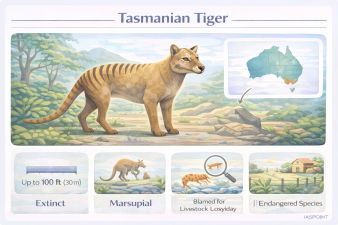
The Tasmanian Tiger (Thylacinus cynocephalus), also known as the Thylacine or Tasmanian Wolf, is an iconic extinct carnivorous marsupial. Despite its name and tiger-like stripes, it was neither a feline nor a canid, but a marsupial that evolved through convergent evolution to fill the ecological niche of an apex predator, similar to the placental wolf.
Taxonomy and Evolutionary Significance
The Thylacine was the only member of the family Thylacinidae to survive into modern times. Its existence is a classic example of how unrelated species can evolve similar physical traits when adapting to similar environments or niches.
| Feature | Details |
| Scientific Name | Thylacinus cynocephalus (meaning “dog-headed pouched-dog”) |
| Class | Mammalia |
| Infraclass | Marsupialia (Marsupials) |
| Status | Extinct (Officially declared by IUCN in 1982) |
| Last Known Individual | “Benjamin,” who died in 1936 at Hobart Zoo, Tasmania. |
Physical Characteristics and Unique Biology
The Thylacine possessed several biological anomalies that distinguish it from other mammals and marsupials.
- Distinctive Stripes: It featured 15 to 20 dark transverse stripes across its sandy-brown back, radiating from the shoulders to the base of the tail.
- The Dual Pouch: Uniquely, both sexes had a pouch. The female’s pouch was back-opening (to protect young while moving through brush), while the male’s pouch acted as a protective sheath for external reproductive organs.
- Stiff Tail and Jaw: It had a thick, stiff tail similar to a kangaroo’s and a remarkable jaw capable of opening to an unusually wide angle (nearly 80 degrees).
- Locomotion: While primarily a quadrupedal runner, anecdotal evidence suggests it was capable of a bipedal “hop” for short distances when startled.
Geographic Range and Extinction Drivers
Historically, the Thylacine was widespread across the Australian mainland and New Guinea before becoming restricted to the island of Tasmania.
Chronology of Decline
- Mainland Extinction (~2,000–3,000 years ago): Likely due to competition with the Dingo (introduced by humans) and changing climatic conditions. Dingoes never reached Tasmania, allowing the Thylacine to persist there.
- Tasmanian Decline (19th Century): Following European settlement, Thylacines were misidentified as “sheep-killers.”
- Bounty Programs: Private companies and the Tasmanian government (1888–1909) offered bounties for every adult Thylacine killed, leading to its rapid decimation.
- Final Extinction: Habitat fragmentation, loss of prey (kangaroos/wallabies), and a distemper-like disease also contributed to its total disappearance by 1936.
Modern Scientific Context: De-extinction (2026 Updates)
The Thylacine is currently a primary candidate for “de-extinction” due to the availability of well-preserved genetic material.
- TIGRR Lab: The University of Melbourne’s Thylacine Integrated Genomic Restoration Research (TIGRR) Lab is working on sequencing the full genome from preserved specimens.
- Colossal Biosciences: In partnership with TIGRR, this biotech firm aims to use CRISPR gene-editing technology. The plan involves using the Fat-tailed Dunnart (its closest living relative, though much smaller) as a surrogate or genetic template to “recreate” a thylacine-like apex predator.
- Ecological Restoration: Proponents argue that reintroducing the Thylacine would help restore the “trophic balance” in Tasmania by controlling overpopulated herbivore species and invasive predators.
UPSC Prelims: Essential Facts and Trivia
- National Threatened Species Day: Commemorated in Australia on September 7th each year to mark the anniversary of the death of the last Thylacine.
- Convergent Evolution: The Thylacine is the most cited example of this biological phenomenon—showing a near-identical skull structure to the Grey Wolf despite being separated by 160 million years of evolution.
- CITES Listing: It remains listed in Appendix I of CITES, despite being extinct, as a procedural safeguard.
- The “Lazarus” Hope: Despite thousands of reported sightings in the Tasmanian wilderness since 1936, no physical evidence (DNA or high-quality photos) has confirmed its survival.