
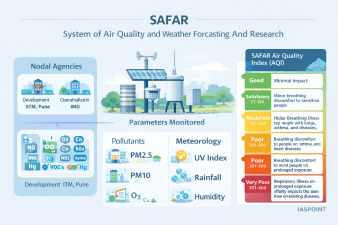
The System of Air Quality and Weather Forecasting And Research (SAFAR) is a national initiative introduced by the Ministry of Earth Sciences (MoES) to provide location-specific information on air quality in near real-time and its forecast 1–3 days in advance in major metropolitan cities. It is India’s first indigenous Air Quality Early Warning System (EWS).
Nodal Agencies and Implementation
The system is a collaborative effort involving premier scientific institutions:
- Development: Developed indigenously by the Indian Institute of Tropical Meteorology (IITM), Pune.
- Operationalization: Implementation and day-to-day operations are managed by the India Meteorological Department (IMD).
- Objective: Originally conceived to monitor air quality during the Commonwealth Games 2010 in Delhi, it has since been expanded to other major metros including Mumbai, Pune, and Ahmedabad.
Parameters Monitored by SAFAR
SAFAR provides a comprehensive 360-degree view of environmental health by monitoring both pollutants and meteorological variables.
Pollutants Monitored
- Particulate Matter: PM2.5 and PM10.
- Gaseous Pollutants: Ozone (O3), Carbon Monoxide (CO), Nitrogen Oxides (NOx), Sulfur Dioxide (SO2).
- Volatile Organic Compounds (VOCs): Benzene, Toluene, and Xylene.
- Heavy Metals: Mercury (Hg).
Meteorological Parameters
- UV Radiation (Solar Index)
- Rainfall
- Temperature
- Humidity
- Wind Speed and Direction
The SAFAR Air Quality Index (AQI)
SAFAR transforms complex scientific data into a simplified, color-coded index to help citizens understand the health implications of the air they breathe.
| AQI Category | Color Code | Health Impact |
| Good (0-50) | Green | Minimal impact. |
| Satisfactory (51-100) | Light Green | Minor breathing discomfort to sensitive people. |
| Moderate (101-200) | Yellow | Breathing discomfort to people with lungs, asthma, and heart diseases. |
| Poor (201-300) | Orange | Breathing discomfort to most people on prolonged exposure. |
| Very Poor (301-400) | Red | Respiratory illness on prolonged exposure. |
| Severe (401-500) | Dark Red/Maroon | Affects healthy people and seriously impacts those with existing diseases. |
Key Features and Advancements (2026 Update)
- Impact-Based Alerts: Since 2024, SAFAR has integrated with the Mission Mausam framework to provide “Impact-Based Forecasts,” predicting how specific pollution levels will affect health and agriculture in real-time.
- Micro-environment Monitoring: Unlike general monitoring, SAFAR stations are placed in diverse micro-environments (Industrial, Residential, Traffic Junctions, and Background/Clean areas) to ensure a representative city average.
- UV Index Forecasting: SAFAR is unique in providing a UVI (Ultra-Violet Index) forecast, which warns citizens about skin-damaging radiation levels, particularly during summer months.
- Last-Mile Dissemination: Data is broadcasted through the Sachet App, outdoor LED displays in cities, and the official SAFAR web portal.
Crucial Facts for UPSC Prelims
- World Meteorological Organization (WMO): SAFAR has been recognized by the WMO as a prototype activity for its high-quality standards and implementation.
- Health Advisory: SAFAR is the only Indian system that provides a dedicated “Health Advisory” based on the specific pollutant that is the “Lead Pollutant” for the day.
- National Clean Air Programme (NCAP): SAFAR serves as a critical data feeder for the NCAP, which aims for a 20-30% reduction in Particulate Matter concentration.
- Difference from CPCB AQI: While the Central Pollution Control Board (CPCB) provides the National AQI for the entire country, SAFAR is a specialized forecasting system primarily focused on high-resolution, city-specific research and early warning.