

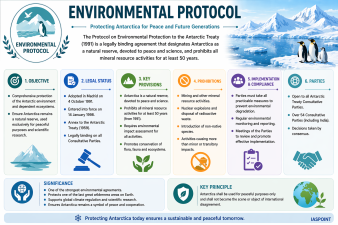
Environmental protocols are formal, multilateral agreements between states intended to address specific ecological threats.
The Ozone Layer Protection Framework
The protection of the stratospheric ozone layer is considered the most successful example of international environmental cooperation.
Vienna Convention (1985)
- It acted as a framework convention, meaning it did not contain legally binding reduction targets for Chlorofluorocarbons (CFCs).
- Focus was on international cooperation for research, monitoring, and information exchange on the ozone layer.
Montreal Protocol (1987)
- Nature: A legally binding protocol that mandates the phase-out of Ozone Depleting Substances (ODS).
- Key Achievement: It is the only UN treaty to date that has been ratified by all 198 UN Member States (Universal Ratification).
- Kigali Amendment (2016): An amendment to the Montreal Protocol to phase down Hydrofluorocarbons (HFCs). While HFCs do not deplete ozone, they are potent greenhouse gases. India has committed to achieving a 10% reduction in HFCs by 2032 and 80% by 2047.
Climate Change and GHG Mitigation
The United Nations Framework Convention on Climate Change (UNFCCC) serves as the parent treaty for major climate protocols.
Kyoto Protocol (1997)
- Objective: To reduce Greenhouse Gas (GHG) emissions based on the principle of “Common But Differentiated Responsibilities and Respective Capabilities” (CBDR-RC).
- Commitment Periods: The first ran from 2008–2012; the second (Doha Amendment) from 2013–2020.
- Flexible Mechanisms:
- Clean Development Mechanism (CDM): Allows Annex I countries to implement emission-reduction projects in developing countries.
- Joint Implementation (JI): Allows Annex I countries to earn emission reduction units from an equivalent project in another Annex I country.
- Emissions Trading: Known as the “carbon market.”
Paris Agreement (2015)
- Goal: To limit global warming to well below 2°C, preferably to 1.5°C, compared to pre-industrial levels.
- Mechanism: Unlike Kyoto’s top-down approach, Paris uses a bottom-up approach through Nationally Determined Contributions (NDCs).
- Global Stocktake: A fundamental component to periodically review collective progress.
Biodiversity and Biosafety Protocols
These protocols stem from the Convention on Biological Diversity (CBD) 1992.
| Protocol | Focus Area | Key Features |
| Cartagena Protocol (2000) | Biosafety | Regulates the movement of Living Modified Organisms (LMOs) resulting from modern biotechnology. |
| Nagoya Protocol (2010) | Access and Benefit Sharing (ABS) | Ensures that benefits arising from the use of genetic resources are shared fairly and equitably. |
| Aichi Targets | Strategic Plan 2011-2020 | A set of 20 targets to halt biodiversity loss (now succeeded by the Kunming-Montreal Global Biodiversity Framework). |
Chemicals and Waste Management Protocols
A triad of conventions manages the lifecycle of hazardous chemicals and waste.
Basel Convention (1989)
- Focuses on the control of transboundary movements of hazardous wastes and their disposal.
- It prevents the “toxic trade” where developed nations export hazardous waste to developing nations.
Rotterdam Convention (1998)
- Covers the “Prior Informed Consent” (PIC) procedure for certain hazardous chemicals and pesticides in international trade.
- It ensures that importing countries are aware of the risks and have the opportunity to refuse the chemicals.
Stockholm Convention (2001)
- Aims to eliminate or restrict the production and use of Persistent Organic Pollutants (POPs).
- The Dirty Dozen: Initially targeted 12 chemicals like DDT and PCBs. India recently banned several of these under the Regulation of Persistent Organic Pollutants Rules.
Minamata Convention (2013)
- A global treaty to protect human health and the environment from the adverse effects of mercury.
- It addresses mercury mining, its use in products (like thermometers), and emissions from industrial plants.
Land Degradation and Desertification
UNCCD (United Nations Convention to Combat Desertification)
- The only legally binding international agreement linking environment and development to sustainable land management.
- Bonn Challenge: A global effort to bring 150 million hectares of the world’s deforested and degraded land into restoration by 2020, and 350 million hectares by 2030.
Important Facts for Prelims
- The Ramsar Convention (1971): While often called a convention, it functions as a protocol for the conservation of wetlands. India currently has 85 Ramsar sites (as of 2024).
- CITES (1973): Regulates international trade in endangered species of wild fauna and flora. It is legally binding on parties but does not take the place of national laws.
- CMS (Bonn Convention): Provides a global platform for the conservation of migratory animals and their habitats.
- GEF (Global Environment Facility): Serves as a financial mechanism for five major conventions: CBD, UNFCCC, UNCCD, Stockholm (POPs), and Minamata (Mercury).