

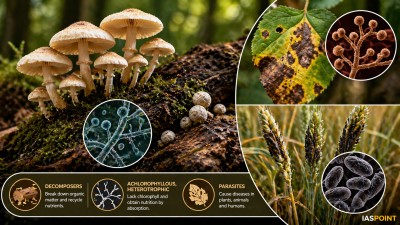
Fungi are eukaryotic, achlorophyllous, heterotrophic organisms that play a dual role as decomposers and parasites. Unlike Algae, they lack photosynthetic pigments and obtain nutrition through absorption.
Role in Medicine and Healthcare
Fungi are the primary source of several life-saving drugs and biochemicals.
- Antibiotics: The first antibiotic, Penicillin, was derived from the fungus Penicillium notatum by Alexander Fleming. Others include Griseofulvin, used for treating fungal skin infections.
- Immunosuppressants: Cyclosporin A, used to prevent organ rejection in transplant patients, is produced by the fungus Trichoderma polysporum.
- Statins: Produced by the yeast Monascus purpureus, these are used as blood-cholesterol lowering agents by inhibiting the enzyme responsible for cholesterol synthesis.
- Ergot: Obtained from Claviceps purpurea, it is used in medicines to control uterine hemorrhage and treat migraine.
Industrial and Commercial Applications
The fermentation capability of fungi, particularly yeasts, forms the backbone of the global biotechnology industry.
- Brewing and Baking: Saccharomyces cerevisiae (Brewer’s yeast) is used for fermenting malted cereals and fruit juices into ethanol, and in the baking industry to make bread porous and light.
- Organic Acids: Fungi are used for the industrial production of organic acids. For example, Aspergillus niger is used for Citric acid production, while Rhizopus nigricans is used for Fumaric acid.
- Enzyme Production: Amylase, Protease, and Lipase are commercially extracted from fungal species for use in detergents and food processing.
Fungi in Agriculture and Soil Fertility
Fungi are essential for nutrient cycling and enhancing plant productivity through symbiotic relationships.
- Mycorrhiza: This is a symbiotic association between fungi (e.g., genus Glomus) and the roots of higher plants. The fungus absorbs phosphorus from the soil and passes it to the plant, while the plant provides energy to the fungus.
- Decomposition: Saprophytic fungi break down complex organic matter (lignin and cellulose) from dead plants and animals into simpler inorganic minerals, replenishing the soil.
- Bio-pesticides: Certain fungi like Beauveria bassiana and Trichoderma species are used as bio-control agents to manage plant pathogens and pests without chemical toxicity.
Fungi as a Direct Food Source
Fungi contribute significantly to human nutrition, though caution is required due to poisonous varieties.
- Edible Mushrooms: Species such as Agaricus bisporus (Button mushroom), Pleurotus (Oyster mushroom), and Morchella (Morels/Guchhi) are rich in proteins, minerals, and vitamins.
- Nutritional Content: They are low in calories and fat but high in Vitamin D, B-complex, and essential amino acids.
- Note on Toxicity: Certain “Toadstools” like Amanita phalloides are highly poisonous and can be fatal if consumed.
Comparative Table: Major Fungi Classes and Economic Impact
| Class | Common Name | Example | Economic Importance |
| Phycomycetes | Lower Fungi | Albugo, Mucor | Parasitic on plants; causes white rust in mustard. |
| Ascomycetes | Sac Fungi | Penicillium, Yeast | Antibiotic production; Fermentation; Research (Neurospora). |
| Basidiomycetes | Club Fungi | Agaricus, Ustilago | Edible mushrooms; Crop diseases (Smut and Rust). |
| Deuteromycetes | Imperfect Fungi | Trichoderma, Alternaria | Decomposition of litter; Mineral cycling; Bio-control agents. |
Negative Economic Impacts (Pathogenic Role)
While beneficial, fungi also cause significant economic loss through diseases and spoilage.
- Plant Diseases: Late blight of potato (Phytophthora infestans), Wheat rust (Puccinia), and Red rot of sugarcane (Colletotrichum falcatum).
- Human Diseases: Ringworm (Microsporum, Trichophyton), Athlete’s foot, and Candidiasis.
- Food Spoilage: Molds like Rhizopus (Bread mold) and Aspergillus cause the rotting of stored fruits, vegetables, and grains. Aspergillus flavus produces Aflatoxins, which are carcinogenic and contaminate stored peanuts and maize.
Key Facts and Trivia for UPSC Prelims
- Guchhi Mushroom: Morchella esculenta, found in the Himalayan region, is one of the world’s most expensive mushrooms and was recently in news regarding GI Tagging efforts.
- Drosophila of Plant Kingdom: The fungus Neurospora crassa is extensively used in biochemical and genetic work, earning it this nickname.
- Lichens: A symbiotic association between Algae (Phycobiont) and Fungi (Mycobiont). The fungus provides shelter and absorbs minerals/water, while the alga prepares food. Lichens are excellent air pollution indicators (they do not grow in SO2 polluted areas).
- LSD (Lysergic Acid Diethylamide): A powerful hallucinogen derived from Ergot fungi (Claviceps).