

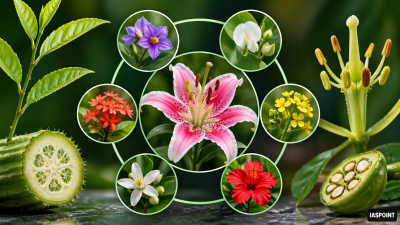
Angiosperms are categorized into various families based on floral morphology, vegetative characters, and reproductive features.
1. Brassicaceae (Cruciferae) – The Mustard Family
Commonly known as the mustard family, these plants are mostly herbaceous and are characterized by their “cruciform” (cross-shaped) corolla.
- Floral Features: Four sepals and four petals arranged in a cross; Tetradynamous stamens (six stamens: four long and two short).
- Fruit Type: Siliqua or Silicula.
- Key Species:
- Food: Brassica oleracea (Cabbage, Cauliflower, Broccoli), Brassica rapa (Turnip).
- Oilseeds: Brassica juncea (Indian Mustard), Brassica napus (Rapeseed).
- Trivia: The pungent odor of mustard is due to the presence of Glucosinolates.
2. Fabaceae (Papilionaceae) – The Legume Family
Formerly known as Leguminosae, this family is critical for soil fertility and protein security.
- Floral Features: Zygomorphic (bilateral symmetry) flowers; Papilionaceous corolla (consisting of a standard, two wings, and a keel).
- Root Characteristics: Presence of Root Nodules containing nitrogen-fixing bacteria (Rhizobium).
- Key Species:
- Pulses: Cajanus cajan (Pigeon pea/Arhar), Cicer arietinum (Gram), Lens culinaris (Lentil).
- Oils: Arachis hypogaea (Groundnut), Glycine max (Soybean).
- Dyes & Fibers: Indigofera tinctoria (Indigo), Crotalaria juncea (Sunn hemp).
- Medicinal: Glycyrrhiza glabra (Mulethi).
3. Solanaceae – The Potato Family
Often referred to as the “Nightshade family,” it includes many diverse vegetables and medicinal plants.
- Floral Features: Pentamerous flowers; Epipetalous stamens (stamens attached to petals); Persistent calyx (the green sepals remain attached to the fruit).
- Key Species:
- Vegetables: Solanum tuberosum (Potato), Solanum lycopersicum (Tomato), Solanum melongena (Brinjal), Capsicum annuum (Chilli).
- Medicinal: Atropa belladonna (Belladonna), Withania somnifera (Ashwagandha).
- Fumigatory: Nicotiana tabacum (Tobacco).
4. Poaceae (Gramineae) – The Grass Family
This is the most economically significant family for human survival, consisting of all major cereals.
- Floral Features: Flowers are called florets and are arranged in spikelets; Perianth is reduced to small scales called lodicules.
- Fruit Type: Caryopsis (a dry one-seeded fruit where the seed coat is fused with the fruit wall).
- Key Species:
- Cereals: Triticum aestivum (Wheat), Oryza sativa (Rice), Zea mays (Maize), Hordeum vulgare (Barley).
- Sugar: Saccharum officinarum (Sugarcane).
- Structural: Bambusa (Bamboo – the “Green Gold”).
5. Liliaceae – The Lily Family
A characteristic monocot family, mostly consisting of perennial herbs with underground bulbs, corms, or rhizomes.
- Floral Features: Perianth is present (sepals and petals are not distinct and are called tepals); Usually six tepals in two whorls of three.
- Key Species:
- Vegetables: Allium cepa (Onion), Allium sativum (Garlic).
- Medicinal: Aloe vera.
- Ornamental: Tulipa (Tulip), Lilium (Lily).
- Colchicine: Colchicum autumnale (Used in doubling chromosome numbers in plant breeding).
6. Malvaceae – The Mallow Family
Known primarily for fiber-yielding plants and specific floral structures.
- Floral Features: Presence of an Epicalyx; Monadelphous stamens (stamens fused into a single tube around the style).
- Key Species:
- Fiber: Gossypium (Cotton).
- Vegetable: Abelmoschus esculentus (Lady’s Finger/Bhindi).
- Ornamental: Hibiscus rosa-sinensis (China Rose).
Summary Table: Diagnostic Floral Structures
| Family | Distinctive Feature | Key Economic Product |
| Brassicaceae | Tetradynamous stamens | Edible oils |
| Fabaceae | Root nodules, Keel petals | Dietary proteins |
| Solanaceae | Persistent calyx, Epipetalous stamens | Vegetables and alkaloids |
| Poaceae | Caryopsis fruit, Lodicules | Cereal grains |
| Liliaceae | Tepals (Perianth) | Bulbs and medicinal extracts |
| Asteraceae | Capitulum (Head) inflorescence | Sunflower oil |
UPSC Trivia for Quick Revision
- Asteraceae (Compositae): Considered the most highly evolved family of dicots (e.g., Sunflower, Marigold). It features a “Capitulum” inflorescence where many small flowers act as a single large flower to attract pollinators.
- Orchidaceae: One of the largest families of angiosperms, featuring highly specialized pollination mechanisms and tiny, dust-like seeds.
- Cucurbitaceae: The Gourd family (Gourd, Cucumber, Watermelon), characterized by climbing vines with tendrils and unisexual flowers.
- Rutaceae: The Citrus family (Lemon, Orange), notable for oil glands in leaves and fruits (hesperidium).