

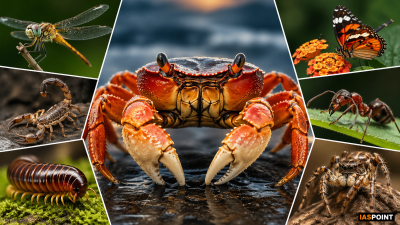
Arthropoda is the largest phylum in the Animal Kingdom, encompassing over 80% of all known living animal species. Derived from the Greek words arthros (jointed) and podos (foot), these organisms are characterized by their jointed appendages and chitinous exoskeletons. They inhabit diverse ecosystems, ranging from deep-sea thermal vents to high-altitude mountain ranges.
Anatomical and Physiological Characteristics
Body Organization and Symmetry
- Level of Organization: Arthropods exhibit an organ-system level of organization.
- Symmetry: They are bilaterally symmetrical, meaning the body can be divided into identical left and right halves along a single plane.
- Triploblastic Nature: The body develops from three germ layers: the ectoderm, mesoderm, and endoderm.
- Segmentation: The body is metamerically segmented and typically divided into the head, thorax, and abdomen. In some groups like crustaceans and arachnids, the head and thorax fuse to form a cephalothorax.
Exoskeleton and Molting
- Composition: The body is covered by a tough, non-living cuticle made of chitin, a nitrogenous polysaccharide.
- Function: It provides physical protection, supports the internal organs, and prevents desiccation (water loss), which is crucial for terrestrial survival.
- Ecdysis (Molting): Since the exoskeleton is rigid and does not grow, arthropods must periodically shed it and grow a new one to increase in size.
Appendages and Locomotion
- Jointed Legs: The presence of jointed appendages is the hallmark of this phylum, allowing for high mobility and specialized functions like swimming, jumping, and walking.
- Specialized Limbs: Appendages are often modified into antennae for sensing, mandibles for feeding, or wings for flight (in insects).
Internal Biological Systems
Circulatory and Respiratory Systems
- Open Circulatory System: Blood, known as hemolymph, flows through open spaces called lacunae or sinuses rather than being confined to vessels. The body cavity is a hemocoel.
- Respiratory Organs: These vary significantly based on habitat:
- Gills: Found in aquatic forms like prawns.
- Book Gills: Found in King crabs (Limulus).
- Book Lungs: Found in arachnids like scorpions and spiders.
- Tracheal System: A network of tubes found in terrestrial insects.
Digestive and Excretory Systems
- Complete Digestive Tract: Arthropods possess a complete gut with a mouth and an anus.
- Excretion: Waste removal is handled by specialized organs:
- Malpighian Tubules: Typical in insects and centipedes.
- Green Glands (Antennal Glands): Found in crustaceans like prawns.
- Coxal Glands: Found in spiders.
Nervous System and Sensory Organs
- Structure: The nervous system consists of a nerve ring and a ventral, solid, and double nerve cord.
- Sensory Organs: They possess antennae (tactile and chemical sensors), statocysts (balancing organs), and eyes.
- Vision: Arthropods may have simple eyes (ocelli) or compound eyes, the latter consisting of several thousand independent visual units called ommatidia.
Reproduction and Development
- Sexes: Most arthropods are dioecious (separate sexes).
- Fertilization: Usually internal in terrestrial forms and external in aquatic forms.
- Oviparous: Most species lay eggs.
- Development: May be direct or indirect (involving larval stages and metamorphosis).
Classification and Key Examples
| Class | Characteristic Features | Examples |
| Insecta | Three pairs of legs; body divided into head, thorax, abdomen. | Apis (Honey bee), Anopheles (Mosquito) |
| Arachnida | Four pairs of legs; cephalothorax present; no antennae. | Spiders, Scorpions, Ticks |
| Crustacea | Mostly aquatic; two pairs of antennae; cephalothorax. | Palaemon (Prawn), Cancer (Crab) |
| Myriapoda | Many legs; elongated bodies. | Centipedes, Millipedes |
| Merostomata | Primitive marine forms; breathe through book gills. | Limulus (King Crab) |
Economic and Ecological Importance
Economically Important Insects
- Apis (Honey bee): Producer of honey and wax; vital pollinator.
- Bombyx (Silkworm): Source of silk fiber.
- Laccifer (Lac insect): Used in the production of shellac.
Disease Vectors
- Anopheles: Vector for Malaria.
- Culex: Vector for Filariasis.
- Aedes: Vector for Dengue and Zika.
Agricultural Pests
- Locusta (Locust): Gregarious pests known for destroying vast areas of crops.
Living Fossils
- Limulus (King Crab): Often cited in UPSC Prelims as a “living fossil” because it has remained virtually unchanged for millions of years.
Fact Sheet for UPSC Prelims
- Largest Class: Insecta is the largest class within the Phylum Arthropoda.
- Respiration Fact: Spiders and Scorpions do not have a tracheal system; they rely on book lungs.
- Excretion Fact: Malpighian tubules are unique because they are located between the midgut and hindgut.
- Unique Pigment: Unlike the iron-based hemoglobin in humans, some arthropods use hemocyanin (copper-based), which gives their blood a blue tint when oxygenated.