

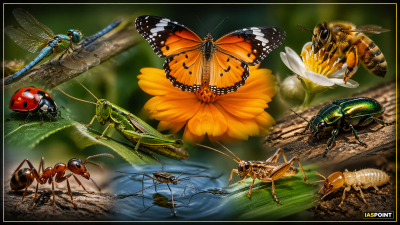
Class Insecta is the most diverse group within the Phylum Arthropoda, containing over a million described species. They are the only invertebrates capable of flight, which has allowed them to colonize almost every terrestrial and freshwater habitat on Earth.
Morphological Characteristics (Body Structure)
The insect body is covered by a chitinous exoskeleton and is strictly divided into three distinct regions: the head, thorax, and abdomen.
1. The Head
- Sensory Hub: Contains one pair of antennae which serve as olfactory and tactile receptors.
- Vision: Typically consists of a pair of compound eyes (composed of ommatidia) and often several simple eyes (ocelli).
- Mouthparts: Highly modified based on feeding habits:
- Biting and Chewing: Cockroaches, Grasshoppers.
- Piercing and Sucking: Mosquitoes, Aphids.
- Siphoning: Butterflies, Moths.
- Sponging: Houseflies.
2. The Thorax
- Locomotion Center: Divided into three segments: prothorax, mesothorax, and metathorax.
- Legs: Three pairs of jointed legs (one pair per segment), leading to the classification name Hexapoda.
- Wings: Usually two pairs of wings attached to the meso- and metathorax. Some insects, like flies (Diptera), have the hind wings reduced to balancing organs called halteres.
3. The Abdomen
- Vital Functions: Contains the majority of the digestive, excretory, and reproductive organs.
- Segmentation: Usually consists of 10 to 11 segments.
- Appendages: Generally lacks walking legs, but may have terminal appendages like cerci or an ovipositor (in females for egg-laying).
Physiology and Internal Systems
- Respiration: Occurs through a Tracheal System. Air enters through lateral openings called spiracles and is distributed directly to tissues via tracheoles, bypassing the need for blood-based oxygen transport.
- Excretion: Primarily through Malpighian tubules, which convert nitrogenous waste into uric acid (Uricotelism), an adaptation to conserve water.
- Circulation: An open system where hemolymph bathes the organs in the hemocoel. The “heart” is a dorsal tubular vessel.
Life Cycle and Metamorphosis
Insects undergo metamorphosis, a biological process of physical development after birth or hatching.
Types of Metamorphosis
- Ametabolous (No Metamorphosis): The young (nymphs) look exactly like adults except for size and sexual maturity. (e.g., Silverfish).
- Hemimetabolous (Incomplete Metamorphosis): Includes three stages: Egg → Nymph → Adult. Nymphs often inhabit the same environment as adults but lack wings. (e.g., Grasshoppers, Dragonflies).
- Holometabolous (Complete Metamorphosis): Includes four distinct stages: Egg → Larva → Pupa → Adult. The larva (caterpillar/maggot/grub) looks entirely different from the adult. (e.g., Butterflies, Beetles, Mosquitoes).
Classification of Common Larval Forms
| Insect | Larval Name |
| Butterfly/Moth | Caterpillar |
| Housefly | Maggot |
| Beetle | Grub |
| Mosquito | Wriggler |
Ecological and Economic Trivia for UPSC
- Pollination: Approximately 75% of crop plants depend on insect pollinators like bees and butterflies.
- Social Structure: Insects like ants, termites, and honeybees exhibit Eusociality, characterized by cooperative brood care, overlapping generations, and a division of labor (castes).
- Bioluminescence: Some insects, like fireflies (Lampyridae), produce “cold light” through a chemical reaction involving the enzyme luciferase.
- Pheromone Communication: Ants use trail pheromones to lead colony members to food sources; silkworm moths use sex pheromones (Bombykol) to find mates over long distances.
- Diapause: A period of suspended development or dormancy used by many insects to survive unfavorable environmental conditions like extreme winters.