

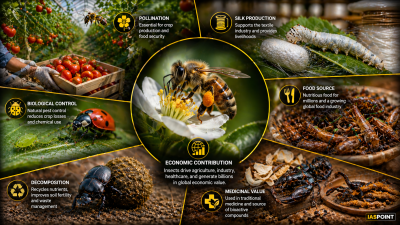
Insects are not merely ecological entities but significant contributors to the global economy.
1. Productive Insects
These insects are reared commercially for the valuable substances they produce. This sector is often referred to as “Commercial Entomology.”
Sericulture: The Silk Insect (Bombyx mori)
- Product: Silk, a natural protein fiber.
- Biology: The larvae (caterpillars) of the Silkworm moth secrete liquid silk through salivary glands, which hardens into a cocoon.
- Key Facts: ” Mulberry silk accounts for the majority of global production.
- Non-mulberry varieties in India include Tussar, Muga (exclusive to Assam), and Eri silk.
- India is the second-largest producer of silk globally.
Apiculture: The Honey Bee (Apis species)
- Products: Honey, Beeswax, Royal Jelly, and Bee Venom.
- Species in India: ” Apis dorsata (Rock bee – high honey yield but aggressive).
- Apis indica (Indian bee – easily domesticated).
- Apis florea (Little bee).
- Apis mellifera (European bee – widely used for commercial apiculture).
- Industrial Use: Beeswax is a critical raw material for the cosmetics, polish, and pharmaceutical industries.
Lac Culture: The Lac Insect (Laccifer lacca)
- Product: Lac, a natural resin.
- Biology: The insect lives as a parasite on host trees (like Kusum, Palas, and Ber), secreting a protective resinous covering.
- Uses: Used in the manufacture of bangles, sealing wax, varnishes, and electrical insulation.
- Fact: India is the leading producer of lac in the world, with Jharkhand being a major hub.
2. Insects in Agriculture and Horticulture
Beyond direct products, insects provide indirect economic benefits worth billions of dollars through ecosystem services.
Pollinators
- Economic Impact: Pollination increases the yield and quality of fruits, vegetables, and oilseeds.
- Primary Agents: Bees, Bumblebees, Butterflies, and Hoverflies.
- Trivia: Without insect pollinators, the production of crops like almonds, coffee, and cocoa would collapse.
Biological Control Agents (Natural Pesticides)
- Function: Used in Integrated Pest Management (IPM) to destroy agricultural pests without chemicals.
- Ladybird Beetles: Used to control aphids and scale insects.
- Dragonflies: Control mosquito populations and midges.
- Trichogramma: A parasitic wasp used to control sugarcane borers and cotton bollworms.
3. Summary of Commercial Insect Products
| Insect | Scientific Name | Primary Product | Primary Use |
| Silkworm | Bombyx mori | Silk | Textiles |
| Honey Bee | Apis mellifera | Honey & Wax | Food, Medicine, Cosmetics |
| Lac Insect | Laccifer lacca | Lac Resin | Jewelry, Polishes, Sealing |
| Cochineal | Dactylopius coccus | Carmine Dye | Food coloring, Cosmetics |
| Spanish Fly | Lytta vesicatoria | Cantharidin | Medical (Blistering agent) |
4. Insects as Food (Entomophagy)
- Nutritional Value: Insects are rich in protein, healthy fats, and minerals (Iron, Zinc).
- Economic Shift: With the rise of sustainable food movements, crickets (Acheta domesticus) and mealworms are being processed into flour for the global market.
- Environmental Edge: Insect farming requires significantly less land and water compared to traditional livestock like cattle.
5. Harmful Economic Impact: Agricultural Pests
While many are beneficial, some insects cause massive economic losses.
- Locusts (Schistocerca gregaria): Migratory pests that can destroy entire harvests in hours.
- Termites: Cause structural damage to timber and buildings.
- Stored Grain Pests: Insects like the Rice Weevil (Sitophilus oryzae) destroy food reserves in warehouses.
Key Facts for UPSC Prelims
- Living Fossil: Limulus (King Crab) is used in the medical industry to test for bacterial contamination in vaccines due to its unique blue blood.
- Pheromones in Economy: Synthetic pheromones are used in agriculture to create “mating disruption” traps, an eco-friendly way to manage pest populations.
- Dye Production: Cochineal insects, which live on cacti, are the source of natural red dye (Carmine) used widely in the food and beverage industry.