

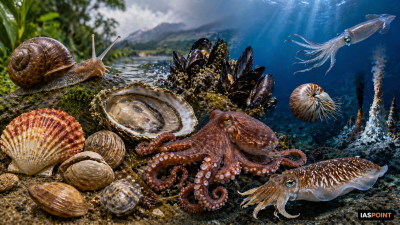
Molluscs constitute the second-largest animal phylum and occupy diverse habitats ranging from terrestrial landscapes to the deepest oceanic trenches.
Ecological Importance of Molluscs
Molluscs serve as foundational components of marine and freshwater ecosystems, acting as environmental regulators and indicators.
- Bio-indicators of Water Quality: Bivalves like mussels and oysters are sensitive to changes in water chemistry. They bioaccumulate heavy metals and toxins, helping scientists monitor pollution levels in aquatic environments.
- Natural Water Filters: Bivalves are filter feeders. A single oyster can filter up to 180 liters of water per day, removing suspended particles, algae, and excess nutrients, which prevents eutrophication and maintains water clarity.
- Carbon Sequestration: Molluscs utilize dissolved calcium carbonate to build their shells. This process acts as a “carbon sink,” helping to regulate the global carbon cycle by locking CO2 into mineral form.
- Habitat Engineering: Oysters and mussels create “biogenic reefs.” These structures provide complex three-dimensional habitats for hundreds of other marine species, increasing local biodiversity.
- Food Chain Dynamics: Molluscs are a primary food source for a wide array of predators, including fish, birds, and marine mammals (e.g., sperm whales feed almost exclusively on giant squid).
Economic Importance of Molluscs
The economic utility of molluscs spans food security, jewelry, and pharmaceutical industries.
1. Food and Nutrition (Shellfish Industry)
Molluscs are a significant source of high-quality protein, Omega-3 fatty acids, and essential minerals (Zinc, Iron, Iodine).
- Edible Species: Oysters (Ostrea), Mussels (Mytilus), Clams, Scallops, and Cephalopods like Squid (Loligo) and Octopus.
- Gastropods: Snails like Pila (Apple Snail) are consumed in various parts of India and Southeast Asia.
2. The Pearl Industry (Pearl Culture)
The most valuable economic contribution comes from the formation of pearls, a defensive mechanism against irritants.
- Key Species: The Pearl Oyster (Pinctada fucata) is the primary source of high-quality natural and cultured pearls.
- Mechanism: When a foreign particle enters the mantle cavity, the animal secretes layers of Nacre (mother-of-pearl) around it.
3. Source of Lime and Industrial Raw Materials
- Calcium Carbonate: Dead shells of molluscs are collected in large quantities to be processed into lime (Calcium Oxide). This is used in the construction industry, glass manufacturing, and as a soil conditioner in agriculture to neutralize acidity.
- Buttons and Curios: The inner nacreous layer of shells is used to manufacture high-end buttons, jewelry boxes, and decorative ornaments.
4. Pharmaceutical and Medical Research
- Cone Snail Venom: The toxins produced by Conus snails are being researched as potent painkillers (ziconotide), which are significantly more effective than morphine without being addictive.
- Nervous System Models: The Giant Squid (Architeuthis) possesses massive axons, which were historically foundational in neurobiology for understanding how nerve impulses travel.
Malacology vs. Conchology: Key Terminology
| Term | Definition |
| Malacology | The branch of zoology dealing with the study of Molluscs. |
| Conchology | The study of mollusc shells specifically. |
| Torsion | A unique biological process in Gastropods (snails) where the visceral mass rotates 180°, bringing the mantle cavity to the front. |
| Radula | The file-like rasping organ used for feeding, found in all molluscs except Bivalves. |
Threats and Conservation Trivia
- Ocean Acidification: As atmospheric CO2 increases, ocean pH drops. This reduces the availability of carbonate ions, making it difficult for molluscs to form shells, potentially leading to the collapse of shellfish populations.
- The Shipworm (Teredo): Not a worm, but a wood-boring bivalve mollusc. It is economically destructive as it bores into wooden ships, docks, and piers, causing significant infrastructure damage.