

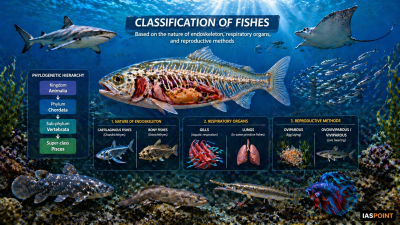
The classification of fishes is based on the nature of their endoskeleton, respiratory organs, and reproductive methods. In the phylogenetic hierarchy, fishes are grouped under the Super-class Pisces within the Sub-phylum Vertebrata.
1. Class: Placodermi (Extinct Fishes)
These are the earliest jawed vertebrates, now entirely extinct. They are characterized by heavy bony armor covering the head and thorax.
- Key Feature: Presence of a primitive jaw and bony plates.
- Example: Climatius, Bothriolepis.
2. Class: Chondrichthyes (Cartilaginous Fishes)
These are primarily marine fishes with a skeleton made entirely of cartilage rather than bone.
Sub-groups and Characteristics
- Elasmobranchii: Includes sharks and rays.
- Holocephali: Includes chimaeras (ratfish).
Key Biological Facts
- Notochord: Persistent throughout life.
- Skin: Tough, containing minute placoid scales (dermal denticles).
- Teeth: Modified placoid scales that are backwardly directed.
- Buoyancy: Lack an air bladder; they must swim constantly to avoid sinking.
- Reproduction: Internal fertilization; many are viviparous.
- Electric/Poison Organs: Some possess specialized organs for defense or predation.
- Torpedo (Electric Ray): Possesses electric organs.
- Trygon (Sting Ray): Possesses a poison sting.
3. Class: Osteichthyes (Bony Fishes)
This class includes both marine and freshwater fishes with a skeleton predominantly made of bone.
Sub-groups and Characteristics
- Actinopterygii (Ray-finned fishes): Most modern bony fishes fall into this category. Their fins are supported by lepidotrichia (bony rays).
- Sarcopterygii (Lobe-finned fishes): Fishes with fleshy, lobed paired fins, which are precursors to tetrapod limbs.
Key Biological Facts
- Mouth: Usually terminal (at the very front).
- Gills: Four pairs of gills covered by an operculum on each side.
- Air Bladder: Present; functions as a hydrostatic organ to maintain buoyancy without active swimming.
- Scales: Skin is covered by cycloid, ctenoid, or ganoid scales.
- Reproduction: Mostly oviparous (egg-laying); fertilization is usually external.
| Feature | Chondrichthyes | Osteichthyes |
| Skeleton | Cartilaginous | Bony |
| Gills | Without Operculum | With Operculum |
| Scales | Placoid | Cycloid/Ctenoid |
| Air Bladder | Absent | Present |
| Tail Fin | Heterocercal (Asymmetrical) | Homocercal (Symmetrical) |
Evolutionarily Significant Groups
Dipnoi (Lungfishes)
Lungfishes are a specialized group of bony fishes that possess both gills and lungs. They are significant in evolutionary biology as “connecting links.”
- Aestivation: They can survive during dry seasons by burying themselves in mud and breathing air.
- Examples: Protopterus (African lungfish), Lepidosiren (South American lungfish), Neoceratodus (Australian lungfish).
Crossopterygii (Coelacanths)
These are ancient lobe-finned fishes once thought to be extinct since the Cretaceous period.
- Trivia: Latimeria chalumnae was rediscovered in 1938 off the coast of South Africa, earning it the title of a “Living Fossil.”
Summary Table of Common Examples for Prelims
| Category | Common Name | Scientific Name | Unique Fact |
| Cartilaginous | Dogfish (Shark) | Scoliodon | Powerful predator with keen sense of smell. |
| Cartilaginous | Sawfish | Pristis | Snout resembles a saw. |
| Bony (Marine) | Flying Fish | Exocoetus | Glides using enlarged pectoral fins. |
| Bony (Marine) | Sea Horse | Hippocampus | Male incubation of eggs in a brood pouch. |
| Bony (Freshwater) | Rohu | Labeo rohita | Major Indian Carp. |
| Bony (Freshwater) | Catla | Catla catla | Fast-growing surface feeder. |
| Bony (Freshwater) | Magur | Clarias batrachus | Can breathe atmospheric air (walking catfish). |
| Bony (Aquarium) | Fighting Fish | Betta | Known for aggressive territorial behavior. |
| Bony (Aquarium) | Angel Fish | Pterophyllum | Popular disc-shaped ornamental fish. |
UPSC Prelims “False Fish” Trivia
Several aquatic organisms have “fish” in their common name but do not belong to the Class Pisces. Candidates must distinguish these for the exam.
- Silverfish: An insect (Arthropoda).
- Cuttlefish: A mollusc (Mollusca).
- Jellyfish: A cnidarian (Coelenterata).
- Starfish: An echinoderm (Echinodermata).
- Whale: A mammal (Mammalia).