

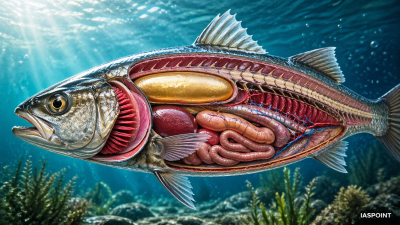
The internal anatomy of fishes is a masterpiece of aquatic adaptation, focusing on buoyancy control, efficient oxygen extraction, and specialized salt balance.
1. Respiratory System: The Gills
Respiration in fishes is almost exclusively branchial, occurring through gills.
- Mechanism: Water is taken in through the mouth and forced over the gill filaments.
- Counter-Current Exchange: Blood flows through the gill capillaries in the opposite direction to the water flow. This ensures maximum oxygen extraction (up to 80-90%) from the water.
- Structure: Each gill consists of a bony or cartilaginous gill arch, gill rakers (which prevent debris from entering), and highly vascularized gill lamellae where gas exchange occurs.
- Accessory Organs: Some species (e.g., Anabas or Climbing Perch) have labyrinth organs that allow them to breathe atmospheric air.
2. Circulatory System: Single Circuit
Fishes possess a closed circulatory system characterized by a “Venous Heart.”
- Heart Structure: A two-chambered heart consisting of one Atrium (Auricle) and one Ventricle.
- Accessory Chambers: Includes the Sinus Venosus (receives deoxygenated blood) and the Bulbus Arteriosus (pumps blood to the gills).
- Single Circulation: The heart only pumps deoxygenated blood. The path is: Heart → Gills (Oxygenation) → Body Tissues → Heart.
- Erythrocytes: Fish red blood cells are typically nucleated and oval.
3. Digestive System and Buoyancy
The digestive tract varies significantly based on diet (carnivorous vs. herbivorous).
- Stomach and Intestine: Carnivorous fishes have shorter intestines, while herbivores have longer, coiled intestines to process plant matter.
- Pyloric Caeca: Many bony fishes have finger-like projections at the junction of the stomach and intestine to increase surface area for digestion and absorption.
- Swim Bladder (Air Bladder): A gas-filled sac found in most Osteichthyes.
- Function: Regulates buoyancy (hydrostatic organ), allowing the fish to maintain depth without swimming.
- Evolutionary Note: In some primitive fishes, it serves as a primitive lung.
4. Nervous and Sensory Systems
- Brain: Relatively small compared to body size. The Olfactory lobes (smell) and Optic lobes (sight) are usually well-developed. The Cerebellum is large in active swimmers to coordinate movement.
- Internal Ear: Fishes lack an external and middle ear. The internal ear functions primarily for equilibrium (balance) rather than complex hearing.
- Weberian Apparatus: In some bony fishes (like Carp), a chain of small bones connects the swim bladder to the inner ear, enhancing hearing by transmitting vibrations.
5. Excretory and Osmoregulatory System
The kidney is the primary excretory organ, located dorsally against the backbone.
- Nitrogenous Waste:
- Ammonotelic: Most freshwater fishes excrete ammonia, which is toxic but highly soluble in water.
- Ureotelic: Cartilaginous fishes (Sharks) often convert ammonia to urea.
- Osmoregulation Table:
| Fish Type | Environmental Tonicity | Osmotic Challenge | Adaptation |
| Freshwater | Hypotonic (Low salt) | Water enters body constantly | Large amounts of dilute urine; salt absorbed via gills. |
| Marine | Hypertonic (High salt) | Water leaves body constantly | Drinks seawater; small amounts of concentrated urine; salts excreted via gills. |
6. Reproductive System
- Gonads: Usually paired testes in males and ovaries in females.
- Cloaca vs. Urogenital Pore: Cartilaginous fishes have a cloaca (common opening for digestive, urinary, and reproductive tracts), whereas bony fishes usually have separate openings.
- Development: * Oviparous: Egg-laying (Most bony fish).
- Ovoviviparous: Eggs hatch inside the mother (Some sharks).
- Viviparous: True live birth with placental connection (Rare, some sharks).
Trivia for Prelims: Anatomy edition
- The “Warm-Blooded” Exception: While most fish are poikilothermic, the Opah (Moonfish) and some Tunas can maintain an internal temperature higher than the surrounding water through specialized muscle activity (Regional Endothermy).
- Milt and Spawn: In fish biology, the mass of eggs is called “spawn,” and the sperm fluid released by males is called “milt.”
- Electric Organs: In eels and rays, these are actually modified muscle or nerve cells (electrocytes) capable of generating significant voltage.