

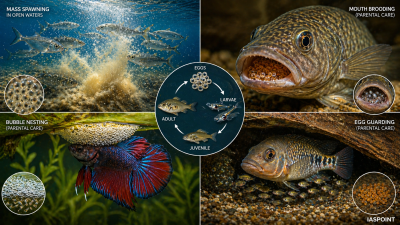
Reproduction in fishes is highly diverse, ranging from mass spawning in open waters to complex parental care.
1. Modes of Reproduction
Fishes are primarily dioecious (separate sexes), though some species exhibit hermaphroditism. They are classified based on how the embryo receives nutrition and where it develops.
- Oviparous (Egg-laying): The most common mode in bony fishes. Females lay eggs, and fertilization is typically external. The embryo depends entirely on the yolk for nutrition. Examples: Rohu, Katla, Salmon.
- Ovoviviparous: Common in many sharks and rays. Eggs are retained inside the female’s body until they hatch. There is no placental connection; nutrition is derived solely from the yolk sac.
- Viviparous (Live-bearing): Rare in fishes but found in some sharks (e.g., Hammerhead). The embryo receives nutrition directly from the mother through a placental-like attachment.
2. Fertilization Mechanisms
- External Fertilization: Typical of most Osteichthyes. Male and female release gametes (milt and spawn) into the water simultaneously. This often requires large quantities of eggs to ensure survival against predation.
- Internal Fertilization: Characteristic of Chondrichthyes. Males possess specialized pelvic fin modifications called Claspers used to transfer sperm into the female’s cloaca.
3. Migratory Patterns (Diadromous Fishes)
Migration for the purpose of breeding is a frequent topic in competitive exams.
| Type of Migration | Movement Direction | Examples |
| Anadromous | From Marine (Sea) to Freshwater (Rivers) | Salmon, Hilsa (Tenualosa ilisha) |
| Catadromous | From Freshwater (Rivers) to Marine (Sea) | Anguilla (Eels) |
| Potamodromous | Entirely within Freshwater (River to Lake) | Certain Carp species |
| Oceanodromous | Entirely within Marine environments | Tuna, Mackerel |
4. Developmental Stages
The life cycle of a fish typically progresses through the following stages:
- Egg Stage: Fertilized zygote protected by a membrane.
- Larval Stage: Upon hatching, the “fry” often carries a yolk sac for initial nourishment.
- Juvenile Stage: The fish resembles a miniature adult but is not yet sexually mature.
- Adult Stage: Capable of reproduction.
5. Parental Care in Fishes
While many fishes abandon their eggs, several species exhibit remarkable parental care to increase survival rates.
- Nest Building: Species like the Stickleback build elaborate nests of aquatic vegetation.
- Mouth Brooding: Certain Cichlids and Catfish carry fertilized eggs or young fry in their mouths for protection.
- Brood Pouches: In Hippocampus (Sea Horse), the male possesses a specialized pouch where the female deposits eggs; the male then carries and “gestates” them until they hatch.
- Skin Attachment: Some catfishes carry eggs attached to their ventral body surface.
6. Evolutionary and Biological Trivia
- Hermaphroditism: Some fishes, like the Clownfish, are sequential hermaphrodites (Protandrous), meaning they can change sex during their lifetime based on social hierarchy.
- Fecundity: This refers to the number of eggs produced by a female. Marine bony fishes often have high fecundity (millions of eggs), whereas cartilaginous fishes have low fecundity but higher offspring survival rates.
- The Hilsa Factor: Tenualosa ilisha (Hilsa) is culturally and economically significant in India (West Bengal); its anadromous nature makes it vulnerable to dam construction (e.g., Farakka Barrage), which obstructs its breeding migration.