

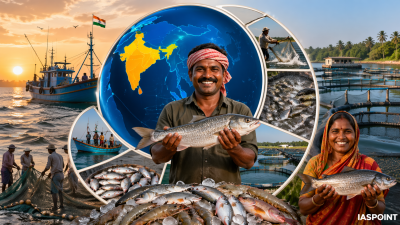
India is the 2nd largest fish-producing nation in the world (after China) and the 2nd largest aquaculture producer. As of 2026, the fisheries sector contributes approximately 1.1% to India’s GVA and over 6.7% to the Agricultural GVA. The sector is recognized as a “Sunrise Sector” due to its potential for providing nutritional security and livelihood to over 30 million people.
1. Classification of Fisheries
Fisheries are broadly divided based on the source of the catch and the nature of the water body.
| Category | Sub-Category | Details |
| Marine Fisheries | Coastal (Off-shore) | Within 12 nautical miles; primarily traditional fishermen. |
| Deep Sea | Beyond 12 nautical miles up to the 200nm Exclusive Economic Zone (EEZ). | |
| Inland Fisheries | Capture Fisheries | Harvesting from natural resources (Rivers, Canals, Reservoirs). |
| Culture Fisheries | Aquaculture in man-made ponds, tanks, and “Amrit Sarovars”. |
- Production Split: Inland fisheries now contribute nearly 75% of India’s total fish production, marking a shift from marine dominance in previous decades.
- Key State: Andhra Pradesh is the leading producer of both inland fish and total fish in India.
2. Types of Aquaculture Systems
Aquaculture involves the farming of aquatic organisms under controlled conditions.
Freshwater Aquaculture
- Composite Fish Culture: A system where 5-6 species (e.g., Catla, Rohu, Mrigal, Grass Carp) are grown in a single pond. Each species occupies a different niche (surface, column, bottom) to maximize resource use.
- Integrated Fish Farming: Combining fish culture with agriculture (paddy-cum-fish) or livestock (poultry/duck-cum-fish), where waste from one serves as nutrients for the other.
Coastal and Marine Aquaculture (Mariculture)
- Brackish Water Farming: Primarily focused on Shrimp (Penaeus monodon and Litopenaeus vannamei). West Bengal (Bheries) and Kerala (Pokkali) use traditional seasonal farming.
- Seaweed Farming: Cultivation of algae like Gracilaria and Kappaphycus on floating rafts; prioritized for women’s self-help groups.
- Cage Culture: Rearing fish in floating net cages in large reservoirs or the open sea.
Technology-Intensive Systems
- Bio-floc Technology: A sustainable method where waste organic matter is converted into protein-rich feed for fish by beneficial bacteria, reducing the need for water exchange.
- Recirculatory Aquaculture System (RAS): High-density farming in tanks where water is continuously filtered and reused; ideal for urban/land-constrained areas.
3. Major Fish and Shellfish Species in India
| Scientific Name | Common Name | Significance |
| Catla catla | Catla | Surface feeder; fastest growing Indian Major Carp. |
| Labeo rohita | Rohu | Column feeder; most popular freshwater fish. |
| Cirrhinus mrigala | Mrigal | Bottom feeder; essential for polyculture. |
| Penaeus monodon | Tiger Prawn | Major export commodity from brackish waters. |
| Litopenaeus vannamei | Whiteleg Shrimp | Exotic species; high-yield backbone of India’s shrimp exports. |
| Macrobrachium rosenbergii | Scampi | Large freshwater prawn; high market value. |
| Tenualosa ilisha | Hilsa | Anadromous fish (migrates sea to river); highly prized in West Bengal. |
4. Government Initiatives and “Blue Revolution 2.0”
Pradhan Mantri Matsya Sampada Yojana (PMMSY)
Launched to bring about the “Blue Revolution” with an investment of ₹20,050 crore (up to 2025-26).
- Targets: 22 million metric tonnes of fish production by 2024-25; doubling exports to ₹1 lakh crore.
- PM-MKSSY (Sub-scheme): Focused on formalizing the unorganized fisheries sector and enhancing digital identities for stakeholders via the National Fisheries Digital Platform (NFDP).
Institutional Support
- Kisan Credit Card (KCC): Extended to fishers and fish farmers to provide working capital at subsidized interest rates.
- FIDF (Fisheries and Aquaculture Infrastructure Development Fund): Provides concessional finance for building fishing harbors, cold chains, and modern markets.
- Blue Economy Policy: A strategic framework to utilize ocean resources sustainably while protecting the marine environment (SDG 14: Life Below Water).
5. Economic Facts and Trivia
- “Pink Gold”: A term used for Shrimp, which dominates India’s seafood export basket (contributing over 70% of total export value).
- Largest Fishing Harbour: Koyilandy in Kerala (Asia’s largest) and Visakhapatnam are major hubs.
- Exclusive Economic Zone (EEZ): India possesses an EEZ of 2.02 million sq. km, providing massive untapped potential for deep-sea fishing.
- False Fish Check: For Prelims, remember that Cuttlefish, Jellyfish, and Silverfish are NOT true fishes (Pisces); they belong to Mollusca, Cnidaria, and Arthropoda respectively.