

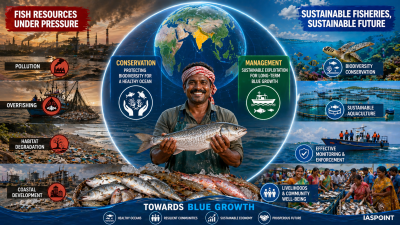
Fish resources are under significant pressure from anthropogenic activities. Conservation involves protecting biodiversity, while management focuses on the sustainable exploitation of these resources to ensure long-term “Blue Growth.”
1. Major Threats to Fish Biodiversity
To address conservation, one must first identify the primary drivers of fish population decline:
- Overexploitation: “Overfishing” occurs when fish are caught faster than they can reproduce, leading to the collapse of stocks (e.g., Atlantic Cod).
- Habitat Destruction: Destruction of mangroves, coral reefs, and estuaries (the “nurseries” of the sea) due to coastal development and pollution.
- By-catch: The incidental capture of non-target species (e.g., Sea Turtles, Dolphins, and juvenile fish) during commercial trawling.
- Eutrophication: Nutrient runoff (Nitrogen/Phosphorus) leads to algal blooms and subsequent Hypoxia (low oxygen), creating “Dead Zones.”
- Invasive Alien Species: Species like the Tilapia or African Catfish (Clarias gariepinus) outcompete indigenous Indian species.
- Climate Change: Ocean acidification (due to CO2 absorption) affects the calcium carbonate shells of prey and the skeletal structure of some fishes.
2. Legal and Institutional Framework in India
India manages its fisheries through a combination of Central and State legislations, divided by the 12-nautical-mile territorial limit.
- Constitutional Provision: “Fisheries” is a State Subject (Entry 21 of the State List), while “Fisheries beyond territorial waters” is a Union Subject (Entry 57 of the Union List).
- Maritime Zones of India Act (1981): Regulates fishing by foreign vessels within India’s Exclusive Economic Zone (EEZ).
- Wildlife Protection Act, 1972: Certain marine species are protected under various schedules.
- Example: The Whale Shark (Rhincodon typus) was the first fish to be protected under Schedule I.
- National Fisheries Policy (2020): Aims to integrate marine, inland, and aquaculture management under a single umbrella for sustainable development.
3. Conservation Strategies and Techniques
Marine Protected Areas (MPAs)
These are geographically defined areas (like Sanctuaries or National Parks) where fishing activity is restricted to allow ecosystems to recover.
- Examples in India: Gahirmatha Marine Sanctuary (Odisha), Gulf of Mannar Marine National Park (Tamil Nadu), and Mahatma Gandhi Marine National Park (Andaman Islands).
Seasonal Fishing Bans (Monsoon Ban)
To protect fish during their spawning (breeding) season, India enforces a uniform 61-day fishing ban along the East and West coasts during the monsoon. This allows populations to replenish.
Technological Interventions
- Turtle Excluder Devices (TEDs): Specialized flaps in trawl nets that allow sea turtles to escape while retaining the fish catch.
- Vessel Monitoring Systems (VMS): Satellite-based tracking to ensure fishing vessels do not enter prohibited or sensitive zones.
- Artificial Reefs: Man-made structures placed on the seabed to provide habitats for fish and promote biodiversity in barren areas.
4. International Conservation Efforts
- UNCLOS (United Nations Convention on the Law of the Sea): The “Constitution of the Oceans,” defining the rights and responsibilities of nations regarding the use of the world’s oceans.
- CITES: Regulates international trade in endangered fish species (e.g., certain sharks and Seahorses).
- IUCN Red List: Provides the conservation status of fish species.
- Critically Endangered (India): Pondicherry Shark, Ganges Shark, and Large-tooth Sawfish.
- SDG 14 (Life Below Water): A global goal to conserve and sustainably use the oceans, seas, and marine resources.
5. Sustainable Management Practices
- Maximum Sustainable Yield (MSY): The largest average catch that can be captured from a stock under existing environmental conditions without depleting the population.
- Total Allowable Catch (TAC): Quotas set by management authorities to limit the total weight of a particular species that can be harvested.
- Blue Carbon Initiative: Protecting coastal ecosystems like mangroves and seagrasses, which are vital fish habitats and major carbon sinks.
6. UPSC Trivia: Conservation Records
- Project Dolphin: Launched by the Government of India for the conservation of both riverine and marine dolphins; dolphins are key indicators of a healthy aquatic ecosystem.
- Ganges River Dolphin: India’s National Aquatic Animal; its presence indicates the health of the Ganga-Brahmaputra river system.
- Ghost Nets: Discarded fishing nets that continue to trap and kill marine life for decades; their removal is a major focus of marine conservation.