

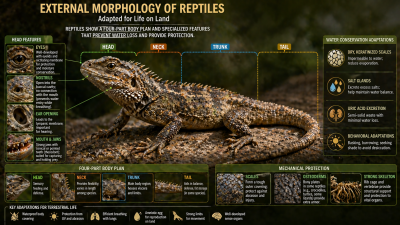
The external morphology of reptiles reflects their complete transition to a terrestrial lifestyle. Their body plan is engineered to conserve water and provide mechanical protection against harsh environments. Most reptiles follow a four-part body division: Head, Neck, Trunk, and Tail.
Integumentary System (Skin and Scales)
The most defining external feature of a reptile is its dry, non-glandular skin.
- Epidermal Scales: Unlike fish scales which are dermal, reptilian scales are epidermal, made of the fibrous protein keratin. This creates a waterproof barrier that prevents desiccation (drying out).
- Scutes: In crocodiles and turtles, the scales are thick and plate-like, often referred to as scutes.
- Osteoderms: In crocodilians and some lizards, bony plates called osteoderms lie beneath the epidermal scales, acting as “body armor.”
- Ecdysis (Moulting): Snakes and lizards periodically shed their skin. Snakes typically shed their skin in a single piece, including the brille (the transparent scale covering the eye).
Cranial Features and Sensory Organs
The head of a reptile contains specialized structures for survival and prey capture.
- Tympanum: Reptiles lack an external pinna (ear flap). The tympanum (eardrum) is usually visible as a small depression or a flat membrane behind the eyes. In snakes, the tympanum is entirely absent; they detect vibrations through the ground via their jawbones.
- Nares: External nostrils are located at the tip of the snout. In crocodilians, these are positioned dorsally to allow breathing while submerged.
- Eyes: Most reptiles have movable eyelids and a nictitating membrane (a transparent third eyelid for protection). Snakes are the exception, having fused, transparent eyelids.
- The Snout: The length and shape vary by diet. For example, the Gharial has an elongated snout specialized for catching fish.
Appendages and Locomotion
Reptilian limbs are adapted for crawling, climbing, or swimming.
- Pentadactyl Limbs: Most reptiles possess four limbs, each ending in five digits tipped with horny claws.
- Limb Positioning: Unlike mammals, reptilian limbs usually sprawl out to the sides, resulting in a characteristic “creeping” or “crawling” gait.
- Vestigial Limbs: Some snakes (like Pythons and Boas) retain “pelvic spurs,” which are evolutionary remnants of hind limbs.
- Adhesive Pads: Some lizards, like the Gecko, have specialized lamellae on their toes that allow them to walk on vertical surfaces and ceilings through Van der Waals forces.
Morphological Variations in Key Groups
| Feature | Snakes | Lizards | Turtles/Tortoises | Crocodilians |
| Limbs | Absent | Typically 4 (some legless) | 4 (Flippers or Stumpy) | 4 (Webbed) |
| Eyelids | Fused (Transparent) | Movable | Movable | Movable |
| Ear Opening | Absent | Present | Absent (Tympanum visible) | Ear Flaps present |
| Tail | Long, tapering | Long (often fragile) | Short | Long, muscular, compressed |
The Tail and its Specializations
The tail in reptiles serves multiple functions beyond mere balance.
- Defense: Many lizards exhibit caudal autotomy, where the tail breaks off at a specific fracture plane to distract a predator. The tail later regenerates, though it is usually cartilaginous rather than bony.
- Fat Storage: Desert-dwelling lizards (like the Gila monster or certain Geckos) store fat reserves in their tails.
- Propulsion: In crocodilians and sea snakes, the tail is laterally compressed to act as a powerful oar for swimming.
Biological Trivia for UPSC Prelims
- The Prehensile Tail: Some reptiles, like the Chameleon, possess a prehensile tail that acts as a fifth limb for gripping branches.
- Carapace and Plastron: In the order Testudines, the dorsal (top) part of the shell is the Carapace, and the ventral (bottom) part is the Plastron. These are actually modified parts of the endoskeleton (ribs and sternum) fused with dermal plates.
- Ghara: In mature male Gharials, a large cartilaginous protuberance called a “Ghara” (pot) develops at the end of the snout, used for sound resonance and bubble-blowing during mating.