

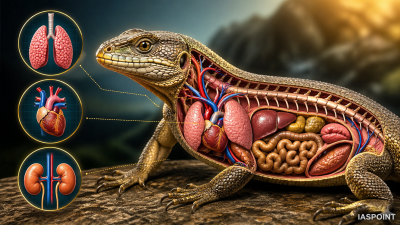
The internal anatomy of reptiles signifies a major evolutionary leap in vertebrate physiology, characterized by improved respiratory efficiency, water conservation, and a more robust circulatory system compared to amphibians.
Digestive System and Metabolism
The digestive tract of reptiles is relatively short, reflecting their primarily carnivorous or insectivorous diets.
- Dentition: Most reptiles are polyphyodont (teeth are replaced throughout life) and homodont (teeth are similar in shape). Crocodilians possess thecodont dentition (teeth set in bony sockets), similar to mammals.
- Alimentary Canal: It consists of the esophagus, stomach, small intestine, and large intestine. It terminates in the cloaca, a common chamber for digestive, urinary, and reproductive discharge.
- Metabolic Rate: Reptiles have a low basal metabolic rate. Being ectothermic, they require significantly less food than birds or mammals of the same size.
Circulatory System
The reptilian heart is designed to separate oxygenated and deoxygenated blood more effectively than the amphibian heart.
- Heart Chambers: Most reptiles (lizards, snakes, turtles) possess a three-chambered heart consisting of two atria and one partially divided ventricle.
- The Ventricular Septum: An incomplete septum (wall) in the ventricle reduces the mixing of blood.
- Crocodilian Heart: Crocodiles possess a fully four-chambered heart. However, they have a unique “Foramen of Panizza” that allows blood to bypass the lungs during long underwater dives.
- Red Blood Cells (RBCs): Unlike mammals, reptilian RBCs are nucleated and oval in shape.
Respiratory System
Reptiles rely entirely on pulmonary respiration, as their keratinized skin is impermeable to gases.
- Lungs: Reptilian lungs are more complex and have a larger surface area (increased septation) than those of amphibians.
- Mechanism: Most reptiles use aspiration pump breathing. They use intercostal muscles (muscles between ribs) to expand the thoracic cavity, creating negative pressure to draw air in.
- Specialized Breathing: Turtles cannot expand their ribs because they are fused to the shell; they use specialized limb muscles and visceral movement to pump air.
Excretory System and Osmoregulation
Reptiles are highly adapted to arid environments through efficient water management.
- Metanephric Kidneys: They possess advanced kidneys (metanephros) that are efficient at filtering waste.
- Uricotelism: Most terrestrial reptiles excrete nitrogenous waste in the form of Uric Acid (uricotelic). Uric acid is relatively non-toxic and insoluble in water, allowing it to be excreted as a thick paste, thereby conserving body water.
- Salt Glands: Marine reptiles (like sea turtles and sea snakes) possess specialized salt glands to excrete excess sodium and potassium ions ingested from seawater.
Nervous System and Sensory Organs
- Brain Structure: The reptilian brain is more developed than the amphibian brain, particularly the cerebrum and cerebellum, coordinating more complex movements and behaviors.
- Jacobson’s Organ (Vomeronasal Organ): A specialized chemical sensing organ located in the roof of the mouth. Snakes and lizards use their forked tongues to “pick up” scent particles and deliver them to this organ for analysis.
- Pit Organs: Some snakes (Pit Vipers, Pythons) possess heat-sensing pits between the eyes and nostrils, allowing them to detect the infrared radiation (body heat) of endothermic prey in total darkness.
Reproductive System
- Internal Fertilization: All reptiles practice internal fertilization. Males typically possess a copulatory organ (a single penis in crocodiles/turtles or paired hemipenes in snakes/lizards).
- Egg Anatomy: The internal environment of the amniotic egg provides the embryo with its own “private pond.”
- Amnion: Encloses the embryo in fluid.
- Allantois: Stores metabolic waste and assists in gas exchange.
- Yolk Sac: Provides nutrients.
Internal Anatomy Comparison Table
| Feature | Squamata (Snakes/Lizards) | Testudines (Turtles) | Crocodilia |
| Heart | 3-chambered | 3-chambered | 4-chambered |
| Nitrogenous Waste | Uric Acid | Urea/Uric Acid | Ammonia/Uric Acid |
| Lungs | Faveolar (honeycomb-like) | Multichambered | Multichambered |
| Teeth | Acrodont/Pleurodont | None (Horny Beak) | Thecodont |
| Reproductive Organ | Hemipenes (Paired) | Single Penis | Single Penis |
UPSC Prelims Trivia: Physiological Adaptations
- Snake Anatomy: Due to their elongated body shape, snakes usually have a reduced or absent left lung; the right lung is highly elongated.
- Temperature-Dependent Sex Determination (TSD): In many reptiles (crocodiles and some turtles), the sex of the offspring is determined by the incubation temperature of the eggs rather than sex chromosomes.
- Hibernation and Aestivation: Reptiles may enter a state of dormancy (Hibernation in winter; Aestivation in summer) to survive extreme temperatures where their internal metabolic processes slow down significantly.