

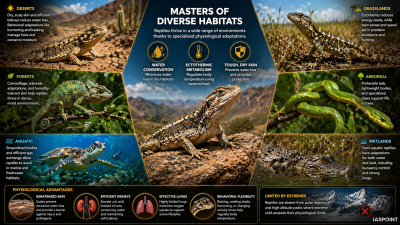
Reptiles are found in nearly every habitat on Earth, excluding the extremely cold polar regions and high-altitude peaks. Their physiology—specifically their water-conserving skin and ectothermic metabolism—allows them to thrive in environments that would be hostile to most mammals.
1. Habitat Diversity and Distribution
Reptiles have diversified into various ecological niches, leading to specialized anatomical adaptations for each.
- Terrestrial (Land-dwelling): The majority of snakes and lizards. Desert species like the Spiny-tailed Lizard (found in Rajasthan) have evolved to survive with minimal water by extracting moisture from succulent plants.
- Arboreal (Tree-dwelling): Species like Chameleons and Vine Snakes. They possess prehensile tails or specialized toe pads for gripping branches.
- Aquatic (Freshwater): Includes the Gharial and Mugger Crocodile, as well as various freshwater turtles (Terrapins).
- Marine (Saltwater): Truly marine reptiles include Sea Turtles (e.g., Green Turtle, Hawksbill) and Sea Snakes. They possess salt glands to excrete excess salt and flipper-like limbs for propulsion.
- Fossorial (Burrowing): Many snakes and lizards live underground. The Shield-tail Snakes of the Western Ghats are a prime Indian example.
2. Ectothermy and Ecological Constraints
The ecology of reptiles is fundamentally governed by their reliance on external heat (Ectothermy).
- Thermal Partitioning: Different species in the same habitat may be active at different times (diurnal vs. nocturnal) to avoid competing for the same thermal resources.
- Hibernation and Aestivation: In temperate climates, reptiles undergo Hibernation (winter sleep). In tropical regions with extreme heat/drought, they may undergo Aestivation (summer sleep) to conserve energy and water.
- Heliothermy: The ecological necessity of “basking” makes reptiles visible in open patches during the morning, a behavior used by researchers for population surveys.
3. Trophic Levels and Feeding Ecology
Reptiles play crucial roles in the food web as both predators and prey.
- Carnivores: Most reptiles are carnivorous. Snakes are specialized predators that control rodent and insect populations, providing an essential “ecosystem service” to agriculture.
- Herbivores: Relatively rare among reptiles, but notable examples include the Green Iguana and various Land Tortoises.
- Apex Predators: Crocodilians and King Cobras sit at the top of their respective food chains, regulating the populations of smaller vertebrates.
- Ambush vs. Active Hunting: * Ambush Predators: (e.g., Vipers, Pythons) rely on camouflage and stay stationary until prey passes by.
- Active Hunters: (e.g., Monitor Lizards, Colubrid snakes) actively forage and pursue their prey.
4. Ecological Adaptations of Indian Reptiles
| Species | Primary Habitat | Specific Ecological Adaptation |
| Gharial | Deep, fast-flowing rivers | Long snout with interlocking teeth specialized for fish-eating (Piscivory). |
| Olive Ridley Turtle | Open Oceans / Sandy Coasts | Synchronized mass nesting (Arribada) to overwhelm predators by sheer numbers. |
| Common Monitor Lizard | Scrub forests / Wetlands | Powerful claws for digging and a long tongue for chemical sensing. |
| King Cobra | Rainforests (Western Ghats/NE) | Ophiophagy (feeding exclusively on other snakes). |
5. Defense Mechanisms and Survival Strategies
Reptiles have evolved diverse strategies to survive in high-predation environments.
- Camouflage (Crypsis): Changing color or possessing patterns that mimic leaves, sand, or bark (e.g., Chameleons, Geckos).
- Mimicry: Non-venomous snakes often mimic the color patterns of venomous ones to ward off predators (e.g., the non-venomous Wolf Snake mimicking the Common Krait).
- Thanatosis: “Playing dead” to discourage predators that only eat live prey (e.g., the Checkered Keelback).
- Caudal Autotomy: Dropping the tail to distract a predator while the lizard escapes.
6. Threats and Conservation Ecology
Reptiles are highly sensitive to environmental changes, making them “Bio-indicators.”
- Habitat Fragmentation: The conversion of forests to agricultural land disrupts the migratory paths of reptiles like the King Cobra.
- Poaching and Illegal Trade: High demand for “Exotic Pets,” tortoise shells, and snake skins for the fashion industry.
- Climate Change: Rising temperatures affect Sex Ratios in species with Temperature-Dependent Sex Determination (TSD), potentially leading to population collapse.
- Pollution: River pollution (heavy metals) bioaccumulates in top predators like Crocodiles, leading to reproductive failure.
7. Major Protected Areas for Reptiles in India
- Bhitarkanika National Park (Odisha): Famous for Saltwater Crocodiles.
- National Chambal Sanctuary (MP/UP/Rajasthan): The last stronghold of the Gharial and Red-crowned Roof Turtle.
- Gahirmatha Marine Sanctuary (Odisha): World’s largest nesting ground for Olive Ridley Turtles.
- Agumbe (Karnataka): Known as the “Capital of King Cobras.”