

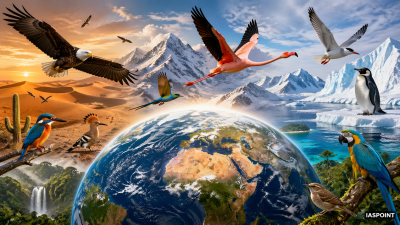
Birds are found across all seven continents, occupying nearly every terrestrial and aquatic habitat on Earth. Their distribution is a result of their high mobility (flight) and endothermic physiology, allowing them to thrive in extreme environments, from the hyper-arid Sahara to the freezing Antarctic.
Global Distribution and Habitats
Birds occupy specific ecological niches based on their physiological adaptations.
| Habitat Type | Key Adaptations | Representative Species |
| Terrestrial (Forests) | Short, rounded wings for maneuverability; zygodactyl feet for climbing. | Woodpeckers, Parrots, Hornbills |
| Terrestrial (Grasslands) | Cryptic plumage for camouflage; strong legs for running. | Great Indian Bustard, Ostriches |
| Aquatic (Marine) | Salt glands; webbed feet; waterproof plumage. | Albatrosses, Penguins, Gulls |
| Aquatic (Freshwater) | Long legs for wading; filter-feeding beaks. | Herons, Flamingos, Ducks |
| Aerial (High Altitude) | Specialized hemoglobin with high oxygen affinity. | Bar-headed Goose, Ruppell’s Vulture |
Ecological Roles of Birds
Birds are vital components of food webs and provide essential ecosystem services that maintain biodiversity.
1. Seed Dispersal (Frugivory)
Many birds consume fruits and excrete the seeds at distant locations. Large birds like Hornbills are known as “Farmers of the Forest” because they are the primary dispersers of large-seeded tropical trees.
2. Pollination (Ornithophily)
Nectar-feeding birds like Sunbirds and Hummingbirds possess long, tubular beaks to reach floral nectar, transferring pollen from one flower to another in the process.
3. Scavenging and Sanitation
Vultures are obligate scavengers that consume decaying carcasses. By removing biological waste, they prevent the spread of diseases such as anthrax, botulism, and rabies. The decline of Indian vultures due to Diclofenac poisoning led to a significant ecological imbalance.
4. Pest Control
Insectivorous birds (e.g., Drongos, Owls, Swallows) act as natural biological control agents by consuming vast quantities of agricultural pests and rodents.
Migration: The Seasonal Ecology
Migration is a synchronized seasonal movement between breeding and non-breeding grounds, driven by food availability and climate.
- Central Asian Flyway (CAF): A major migratory route that covers a large continental area of Eurasia between the Arctic and Indian Oceans. India is a critical “wintering ground” for many birds using this flyway.
- Navigation: Birds use a combination of celestial cues (sun and stars), landmarks, and magnetoreception (sensing the Earth’s magnetic field) to travel thousands of kilometers with pinpoint accuracy.
Birds as Bio-indicators
Birds are highly sensitive to environmental changes, making them excellent indicators of ecosystem health.
- Wetland Health: The presence or absence of migratory waterfowl is used to assess the health of Ramsar Sites.
- Air Quality: Historically, canaries were used in coal mines to detect toxic gases; today, bird population trends reflect the impact of pesticides and air pollution.
Threats and Conservation Status
The ecological stability of birds is currently threatened by various anthropogenic factors:
- Habitat Fragmentation: Destruction of forests and wetlands for infrastructure.
- Electrocution: Large birds like the Great Indian Bustard are highly susceptible to collision with high-tension power lines.
- Chemical Pollution: Pesticides like DDT cause eggshell thinning (biomagnification), while Diclofenac leads to kidney failure in vultures.
- Invasive Species: Feral cats and rats on islands have driven many ground-nesting birds to extinction.
Important Conservation Frameworks
- CITES: Regulates international trade in endangered avian species.
- CMS (Bonn Convention): An intergovernmental treaty aimed at conserving migratory species and their habitats.
- Important Bird Areas (IBAs): Sites identified by BirdLife International as being globally important for the conservation of bird populations.
- Project Bustard: An Indian government initiative focused on the conservation of the Great Indian Bustard, primarily in Rajasthan and Gujarat.
Trivia for UPSC Prelims
- Social Structure: While many birds are solitary, some like the Sociable Weaver build massive communal nests that can house hundreds of individuals.
- Lekking: A specialized mating behavior where males gather in a specific area (a lek) to perform competitive displays to attract females (e.g., Great Indian Bustard).
- Guano: The accumulated excrement of seabirds, which is exceptionally rich in nitrogen and phosphorus, acting as a powerful natural fertilizer and a major economic resource in some regions.