

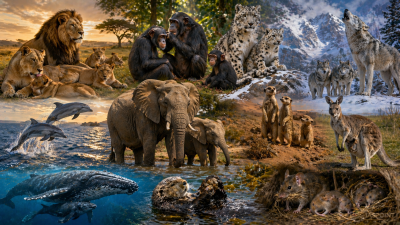
Mammalian behavior is a complex intersection of evolutionary biology and ecological necessity.
Social Organizations and Group Dynamics
Mammals exhibit a spectrum of sociality ranging from solitary lives to highly complex “eusocial” colonies.
Solitary Behavior
- Characteristics: Individuals live alone for most of their lives, interacting only for mating or territorial defense.
- Examples: Tigers, Leopards, and Polar Bears. This is often seen in apex predators that require large territories to ensure enough prey.
Harem and Matriarchal Societies
- Harems (Polygyny): A single dominant male lives with and protects a group of females.
- Examples: Northern Elephant Seals, Lions (Prides), and Gelada Baboons.
- Matriarchal Groups: Societies led by an alpha female, where social bonds are passed through the female line.
- Examples: African Elephants and Orcas. In elephants, the oldest female (matriarch) holds the collective “memory” of water holes and migration routes.
Eusociality in Mammals
- Definition: A rare form of social organization characterized by cooperative brood care, overlapping generations, and a division of labor into reproductive and non-reproductive castes.
- Examples: The Naked Mole-rat and Damaraland Mole-rat. Similar to bees, they have a single “queen” who breeds and “workers” who maintain the colony.
Communication Mechanisms
Mammals utilize diverse sensory channels to maintain social order and coordinate activities.
Chemical Communication (Pheromones)
- Scent Marking: Many mammals use specialized glands to mark territories or signal reproductive readiness.
- Vomeronasal Organ (Jacobson’s Organ): A specialized sensory organ used to detect pheromones. The “Flehmen response” (curling of the upper lip) in ungulates and cats helps direct scents to this organ.
Acoustic and Visual Signals
- Vocalizations: Used for alarm calls (Vervet monkeys have specific calls for leopards vs. snakes), group coordination (Wolves howling), and infant-mother recognition.
- Echolocation: High-frequency clicks used by Bats and Odontoceti (toothed whales) for navigation and social bonding.
- Visual Displays: Body posture, facial expressions in primates, and the “stotting” (high-leaping) of gazelles to signal fitness to predators.
Key Behavioral Adaptations
| Behavior | Description | Significance for Survival |
| Altruism | An individual performs an action that benefits another at its own cost. | Often explained by “Kin Selection” (helping relatives survive). |
| Migration | Seasonal movement from one region to another. | Access to food and breeding grounds (e.g., Humpback Whales, Wildebeests). |
| Territoriality | Defense of a specific area against intruders. | Ensures exclusive access to food, shelter, and mates. |
| Play | Seemingly non-purposeful activity in juveniles. | Essential for developing motor skills and social hierarchies. |
Foraging and Hunting Strategies
- Pack Hunting: Cooperative hunting allows predators to take down prey much larger than themselves.
- Examples: Gray Wolves, African Wild Dogs, and Orcas.
- Hoarding (Caching): Storing food for later use, a vital behavior for mammals in seasonal climates.
- Examples: Squirrels (scatter-hoarding) and Hamsters (larder-hoarding).
Parental Care and Investment
Mammals show the highest level of parental investment among vertebrates, largely due to the physiological demands of lactation.
- K-Selection Strategy: Most mammals produce fewer offspring but invest heavily in their survival, leading to high juvenile survival rates.
- Alloparenting: Individuals other than the biological parents (often older siblings or aunts) assist in caring for the young. This is common in Meerkats and Primates.
Trivia and Fact-Check for UPSC
- The “Selfish Gene”: A theory often applied to mammalian behavior suggesting that altruism is a strategy to ensure the survival of shared genetic material.
- Circadian Rhythms: Biological processes that follow a 24-hour cycle. Mammals can be Diurnal (active during the day), Nocturnal (active at night), or Crepuscular (active at dawn and dusk, like deer).
- Intelligence and Brain Size: The Encephalization Quotient (EQ) is a measure of relative brain size that often correlates with the complexity of social behavior (highest in Humans, Dolphins, and Elephants).