

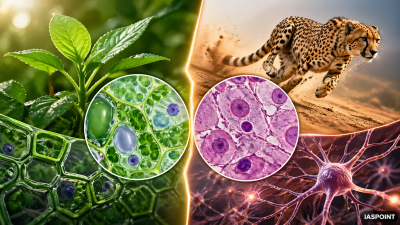
Plant and Animal tissues represent two distinct biological strategies for survival. While plants are stationary autotrophs requiring structural rigidity, animals are mobile heterotrophs requiring rapid coordination and metabolic flexibility.
Fundamental Differences Between Plant and Animal Tissues
| Feature | Plant Tissues | Animal Tissues |
| Mobility | Fixed/Stationary; tissues provide sedentary support. | Mobile; tissues facilitate locomotion and movement. |
| Growth Pattern | Growth is localized to specific regions (Meristems) and continues throughout life. | Growth is generally uniform and restricted to a specific period (Determinate growth). |
| Living vs. Dead | Contain a high proportion of dead supportive tissues (Sclerenchyma, Xylem vessels). | Most tissues are living and require constant energy/oxygen supply. |
| Energy Consumption | Low energy requirement as most tissues are supportive. | High energy requirement to support movement and complex organ systems. |
| Structural Organization | Simple tissue organization; lacks complex organ systems. | Highly complex and specialized organ systems. |
Detailed Comparison of Specialized Tissue Systems
Cellular Characteristics and Matrix
- Cell Wall: Plant tissues are characterized by the presence of a rigid cell wall made of cellulose, hemicellulose, and pectin. Animal tissues lack a cell wall, possessing only a flexible plasma membrane.
- Vacuoles: Plant cells contain large, central permanent vacuoles for maintaining turgor pressure. In animal tissues, vacuoles are small, temporary, or absent.
- Intercellular Matrix: Animal tissues often have a prominent extracellular matrix (e.g., collagen in connective tissue). In plants, the “matrix” is largely the rigid cell wall network.
Growth and Repair Mechanisms
- Meristematic vs. Permanent (Plants): Plant growth is driven by Meristematic tissues (Apical, Lateral, and Intercalary). Once these cells mature, they differentiate into Permanent tissues (Parenchyma, Collenchyma, Sclerenchyma).
- Uniform Cell Division (Animals): Unlike plants, animals do not have “growth zones.” Cell division occurs throughout the body in most tissues during the growth phase, and repair is managed by specialized stem cells.
Functional Specialization
- Conductive Tissues: Plants utilize Xylem (water/minerals) and Phloem (food) for transport. Animals utilize the Circulatory system (Blood and Lymph) which is far more complex and active.
- Supportive Tissues: In plants, mechanical strength is provided by lignin-rich Sclerenchyma. In animals, skeletal tissues (Bone and Cartilage) provide the structural framework.
- Coordination: Plants lack a nervous system; coordination is purely chemical (hormonal). Animals possess complex Nervous and Muscular tissues for rapid response to stimuli.
Specific Tissue Types: A Comparative Summary
Major Plant Tissue Categories
- Simple Permanent Tissues:
- Parenchyma: Living cells, thin-walled, used for storage and photosynthesis (Chlorenchyma).
- Collenchyma: Provides flexibility and mechanical support to young stems.
- Sclerenchyma: Dead cells with thick lignified walls; provides extreme rigidity (e.g., coconut husk).
- Complex Permanent Tissues:
- Xylem: Tracheids, vessels, xylem parenchyma, and xylem fibres.
- Phloem: Sieve tubes, companion cells, phloem parenchyma, and phloem fibres.
Major Animal Tissue Categories
- Epithelial Tissue: Covers body surfaces and lines cavities (e.g., Squamous, Columnar, Ciliated).
- Connective Tissue: Binds and supports other tissues (e.g., Areolar, Adipose, Bone, Cartilage, Blood).
- Muscular Tissue: Responsible for movement (Skeletal, Smooth, and Cardiac muscles).
- Nervous Tissue: Specialized for communication and control (Neurons and Neuroglia).
UPSC Prelims Facts and Trivia
- Totipotency: Plant cells generally retain the ability to differentiate into any cell type (totipotency) more readily than most specialized animal cells.
- Lignification: The presence of Lignin is a hallmark of dead plant tissues (Sclerenchyma), providing the “woody” nature of plants.
- Adipose Tissue: Unique to animals, this connective tissue stores fat and acts as an insulator; plants store fats in the form of oils primarily in seeds (Endosperm).
- Contractile Proteins: While both have movement-related proteins, the Actin-Myosin system in animal muscle tissues allows for the rapid, high-force contraction necessary for locomotion, which is absent in plant structural tissues.