

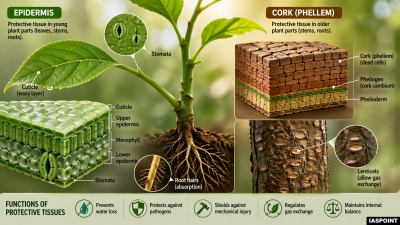
Protective tissues form the outermost layers of the plant body, serving as a primary defense mechanism against environmental stress, pathogens, and mechanical injury. They are specialized to prevent water loss and regulate gas exchange.
1. Epidermis: The Primary Outer Layer
The epidermis is the outermost layer of the primary plant body, covering leaves, flowers, stems, and roots. It is typically one cell layer thick and composed of elongated, compactly arranged living cells.
- Structure: Cells are generally flattened with no intercellular spaces. The outer and lateral walls are often thicker than the inner walls.
- Cuticle: In aerial parts, the epidermis is covered by a waxy, water-resistant layer called the Cuticle. It prevents excessive transpiration and protects against parasitic fungi.
- Note: The cuticle is absent in roots to allow for water absorption.
- Stomata: These are small pores present in the epidermis of leaves and young stems.
- Guard Cells: Each stoma is flanked by two kidney-shaped (dicots) or dumbbell-shaped (monocots/grasses) guard cells. These are the only epidermal cells containing chloroplasts.
- Function: Regulation of gas exchange (O2 and CO2) and transpiration.
- Root Hairs: In roots, epidermal cells (Epiblema) bear long hair-like outgrowths that significantly increase the surface area for water and mineral absorption.
- Trichomes: Epidermal hairs on stems that help in reducing water loss by breaking air flow and providing shade to the stomata.
2. Cork (Phellem): The Secondary Protective Tissue
As woody plants grow older and increase in girth, the primary epidermis is replaced by a tougher, multilayered protective tissue called Cork or Phellem.
- Origin: Produced by the Cork Cambium (Phellogen), a lateral meristem.
- Structure: Cells of cork are dead at maturity and compactly arranged without intercellular spaces.
- Suberin: The cell walls of cork are heavily impregnated with a waxy substance called Suberin.
- Significance: Suberin makes the cork cells impervious to water and gases, providing an airtight and waterproof seal.
- Functions:
- Protects the inner tissues from infection and mechanical injury.
- Acts as an insulator against extreme temperature fluctuations.
- Provides buoyancy to some plants.
3. Lenticels: The Breathing Pores of Bark
Because cork is impervious to gases, woody stems develop specialized openings called Lenticels.
- Structure: Lens-shaped openings where the cork cells are loosely arranged (complementary cells).
- Function: Permit the exchange of gases between the internal tissues of the stem and the atmosphere, facilitating respiration in the living cells of the wood and phloem.
Comparison: Epidermis vs. Cork
| Feature | Epidermis | Cork (Bark) |
| Nature | Living cells | Dead cells |
| Layers | Usually single-layered | Multi-layered |
| Chemical Covering | Cutin (Cuticle) | Suberin |
| Openings | Stomata | Lenticels |
| Occurrence | Young stems, leaves, roots | Older woody stems and roots |
UPSC Prelims Facts and Trivia
- Bulliform Cells: Large, bubble-shaped epidermal cells found in many monocots (like grasses) that help in rolling leaves during water stress to reduce transpiration.
- Commercial Cork: The cork used for bottle stoppers and cricket ball cores is obtained from the bark of the Cork Oak (Quercus suber).
- Epiblema: The specialized epidermis of the root, also known as the Piliferous layer, because it produces root hairs.
- Velamen: A specialized multilayered epidermis found in the aerial roots of epiphytic orchids that helps in absorbing atmospheric moisture.
- Guard Cell Symmetry: In dicots, guard cells are kidney-shaped, while in monocots (Gramineae family), they are dumbbell-shaped—a frequent detail in botanical classifications.