

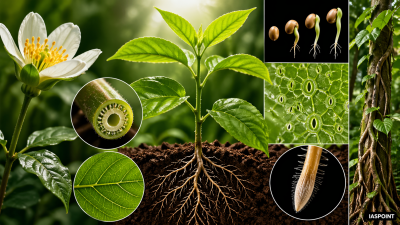
Plant morphology is the study of the physical form and external structure of plants.
The Root System: Anchorage and Absorption
Roots are typically the underground part of the plant axis that lacks nodes, internodes, leaves, and buds. They develop from the radicle of the embryo during seed germination.
Types of Root Systems
- Tap Root System: Primary root develops from the radicle and persists throughout the plant’s life (e.g., Mustard, Gram).
- Fibrous Root System: Primary root is short-lived and replaced by a cluster of thin roots arising from the base of the stem (e.g., Wheat, Paddy).
- Adventitious Root System: Roots arising from parts of the plant other than the radicle (e.g., Banyan tree, Grasses, Maize).
Modifications of Roots
| Modification Type | Function | Examples |
| Storage Roots | Food storage for unfavorable conditions | Carrot (Conical), Radish (Fusiform), Sweet Potato |
| Prop Roots | Mechanical support from hanging branches | Banyan Tree (Ficus benghalensis) |
| Stilt Roots | Support arising from lower nodes of the stem | Maize, Sugarcane |
| Pneumatophores | Respiratory roots for oxygen in swampy areas | Rhizophora (Mangroves) |
The Stem: The Ascending Axis
The stem develops from the plumule of the embryo. It bears nodes (where leaves are born) and internodes (the portion between two nodes).
Underground Stem Modifications
Underground stems are often confused with roots but are distinguished by the presence of nodes and buds.
- Rhizome: Grows horizontally under the soil (e.g., Ginger, Turmeric).
- Tuber: Swollen ends of underground branches (e.g., Potato).
- Bulb: Highly reduced stem with fleshy scale leaves (e.g., Onion, Garlic).
- Corm: Vertically growing fleshy underground stem (e.g., Colocasia, Amorphophallus).
Sub-aerial and Aerial Modifications
- Runners: Spread on the soil surface to help in vegetative propagation (e.g., Grass, Strawberry).
- Stem Tendrils: Spirally coiled structures for climbing (e.g., Gourds, Grapevines).
- Thorns: Woody, straight, and pointed structures for protection (e.g., Citrus, Bougainvillea).
- Phylloclade: Flattened or cylindrical green stems that perform photosynthesis in arid regions (e.g., Opuntia).
The Leaf: The Photosynthetic Unit
Leaves originate from shoot apical meristems and are arranged in an acropetal order. A typical leaf consists of the leaf base, petiole, and lamina.
Venation Patterns
- Reticulate Venation: Veins form a network; characteristic of Dicot plants (e.g., Peepal, Hibiscus).
- Parallel Venation: Veins run parallel to each other; characteristic of Monocot plants (e.g., Banana, Bamboo, Grass).
Phyllotaxy (Arrangement of Leaves)
- Alternate: A single leaf arises at each node (e.g., China rose, Sunflower).
- Opposite: A pair of leaves arise at each node (e.g., Calotropis, Guava).
- Whorled: More than two leaves arise at a node (e.g., Alstonia).
Inflorescence and Flower Structure
The arrangement of flowers on the floral axis is termed inflorescence.
Classification of Inflorescence
- Racemose: The main axis continues to grow; flowers are borne laterally in acropetal succession.
- Cymose: The main axis terminates in a flower; growth is limited and flowers are in basipetal succession.
Parts of a Typical Flower
- Calyx (Sepals): Outermost whorl, generally green and protective.
- Corolla (Petals): Brightly colored to attract pollinators.
- Androecium: Male reproductive part consisting of stamens (filament and anther).
- Gynoecium: Female reproductive part consisting of carpels (stigma, style, and ovary).
The Fruit and Seed
A fruit is a mature or ripened ovary, developed after fertilization. If a fruit is formed without fertilization, it is called a Parthenocarpic fruit (e.g., Banana).
Key Seed Facts
- Dicotyledonous Seeds: Seeds with two cotyledons (e.g., Pea, Gram, Bean).
- Monocotyledonous Seeds: Seeds with one cotyledon (e.g., Maize, Wheat).
- Endospermic Seeds: Seeds where the endosperm (food-storing tissue) is retained (e.g., Castor, Maize).
- Non-endospermic Seeds: Endosperm is consumed during development (e.g., Bean, Gram, Pea).
Botanical Trivia for Prelims
- Largest Leaf: Victoria amazonica (Giant Water Lily).
- Largest Flower: Rafflesia arnoldii.
- Smallest Flower: Wolffia.
- Edible Part of Apple: The Thalamus (making it a “False Fruit”).
- Saffron Source: It is obtained from the dried stigmas and tops of the styles of the Crocus sativus flower.