

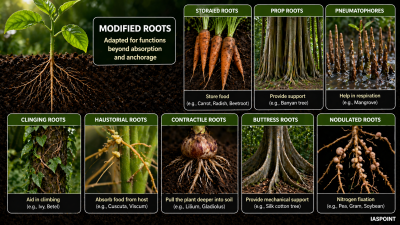
In many plant species, roots undergo permanent structural changes to perform functions beyond water absorption and anchorage.
Modifications of Tap Roots for Food Storage
Tap roots of certain plants become fleshy and swollen due to the accumulation of food reserves. They are classified based on their shape.
| Modification Type | Structural Description | Examples |
| Fusiform | Thickest in the middle and tapering towards both ends. | Radish (Raphanus sativus) |
| Conical | Broad at the base and gradually tapering towards the apex. | Carrot (Daucus carota) |
| Napiform | Top is almost spherical and becomes abruptly thin at the bottom. | Turnip, Beetroot |
| Tuberous | Thick and fleshy but do not maintain any definite shape. | Mirabilis jalapa (Four o’clock plant) |
Modifications for Respiration (Pneumatophores)
Plants growing in oxygen-deficient, waterlogged soil or saline marshes (halophytes) develop specialized roots to facilitate gas exchange.
- Mechanism: These roots grow vertically upwards (negatively geotropic) out of the mud.
- Structure: They contain numerous minute pores called Lenticels or Pneumathodes for the intake of oxygen.
- Significance: Vital for the survival of Mangrove ecosystems.
- Examples: Rhizophora, Avicennia, Sonneratia.
Modifications of Adventitious Roots for Storage
Adventitious roots, which arise from any part of the plant other than the radicle, also modify for storage.
- Tuberous Roots: Swollen roots produced singly (e.g., Sweet Potato). Note: Unlike the potato tuber, this lacks nodes.
- Fasciculated Roots: Swollen roots occurring in clusters at the base of the stem (e.g., Dahlia, Asparagus).
- Nodulose Roots: Only the tips of the roots become swollen (e.g., Curcuma amada or Mango Ginger).
- Moniliform (Beaded) Roots: Roots with swelling at regular intervals, appearing like a string of beads (e.g., Bitter gourd, some Grapes).
Modifications for Mechanical Support
Larger plants require additional structural integrity provided by aerial root modifications.
- Prop Roots: These arise from heavy horizontal branches and grow vertically down into the soil. Upon reaching the ground, they become thick and pillar-like to support the canopy (e.g., Banyan tree).
- Stilt Roots: These arise from the lower nodes of the main stem and grow obliquely downwards into the soil. They act like guy-wires to stabilize the plant (e.g., Maize, Sugarcane, Pandanus or Screwpine).
- Climbing Roots: Found in climbers, these roots arise from nodes or internodes and help the plant cling to a support (e.g., Black pepper, Money plant, Betel).
Modifications for Special Vital Functions
These roots perform physiological tasks unique to the plant’s environmental niche.
- Epiphytic (Hygroscopic) Roots: Found in plants growing on other plants (Epiphytes). They hang freely in the air and possess a specialized tissue called Velamen to absorb atmospheric moisture (e.g., Orchids).
- Photosynthetic (Assimilatory) Roots: Roots that develop chlorophyll and perform photosynthesis when exposed to light (e.g., Tinospora, Trapa).
- Parasitic (Haustorial) Roots: Specialized roots in parasitic plants that penetrate the host tissue to absorb water and nutrients (e.g., Cuscuta).
- Floating Roots: In some aquatic plants, white spongy roots arise from the nodes. These store air (aerenchyma), providing buoyancy and aiding respiration (e.g., Jussiaea).
UPSC Prelims Fact Sheet: Root Modifications
- Sweet Potato vs. Potato: UPSC often tests this distinction. The Sweet Potato (Ipomoea batatas) is a modified Adventitious Root, whereas the Common Potato (Solanum tuberosum) is a modified Underground Stem.
- Nitrogen Fixation: Nodulated roots contain Rhizobium bacteria which convert atmospheric nitrogen into nitrates. This is a hallmark of the Fabaceae (Leguminosae) family.
- Velamen Tissue: This is a multi-layered epidermis found in orchid roots that is highly effective at absorbing water from humid air.
- Negative Geotropism: While most roots grow toward gravity, Pneumatophores are a rare example of roots that grow away from gravity (negatively geotropic).