

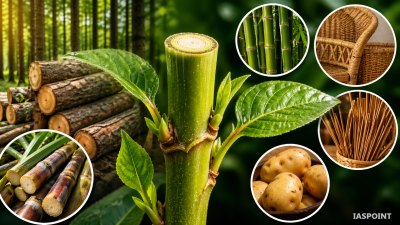
In Plant Morphology, the stem is not only a structural conduit but a significant economic resource.
Stems as Primary Food Sources and Nutrition
Stems serve as major storage organs for carbohydrates, making them a staple in diets worldwide.
- Starch Reservoirs: The Potato (Solanum tuberosum) is the world’s most consumed non-cereal crop. As a modified underground stem (tuber), it provides essential calories.
- Sugar Industry: Sugarcane (Saccharum officinarum) stores sucrose in its stem. It is the primary raw material for the global sugar and ethanol industries.
- Vegetables: Several stems are consumed directly as vegetables, such as Asparagus, Knol-kohl (Ganth Gobi), and Lotus stem (Kamal Kakdi).
- Spices and Flavoring: Ginger and Turmeric are modified underground stems (rhizomes) used globally for their flavor and preservative properties.
Industrial and Commercial Applications
The secondary growth in dicot stems produces wood and fibers that drive multiple industrial sectors.
1. Timber and Wood Industry
The secondary xylem of perennial woody stems provides timber for:
- Construction: Teak, Sal, and Deodar.
- Paper Industry: Softwood stems (Pulpwood) like Pine and Eucalyptus are processed into paper and cellulose products.
2. Natural Fibers
Stems of certain plants are the source of “Bast Fibers” (Phloem fibers) used in textiles and packaging.
- Jute: Obtained from the stem of Corchorus species.
- Flax and Hemp: Stems provide fibers for linen and industrial ropes.
3. Latex, Resins, and Gums
- Rubber: Natural rubber is derived from the latex of the Hevea brasiliensis stem.
- Resins: Turpentine and resins are extracted from the stems of Conifers (Pine).
- Gum Arabic: Sourced from the stem of Acacia senegal.
Medicinal and Pharmaceutical Importance
Stems and their barks contain potent phytochemicals (alkaloids and glycosides) used in life-saving drugs.
| Plant Stem/Bark | Common Name | Medicinal Utility |
| Cinchona bark | Quinine | Primary treatment for Malaria. |
| Cinnamon | Dalchini | Used as a carminative and for blood sugar regulation. |
| Taxus bark | Taxol | A critical anti-cancer drug (Paclitaxel). |
| Tinospora stem | Giloy | Used in Ayurveda as an immunomodulator and for chronic fevers. |
| Ephedra stem | Ephedrine | Used to treat asthma and hay fever. |
Stems in Vegetative Propagation (Agriculture)
The ability of stems to regenerate is exploited in horticulture and agriculture to maintain genetic clones.
- Stem Cuttings: Used for propagating Rose, Sugarcane, and Hibiscus.
- Grafting: A standard practice in fruit orchards (Mango, Apple) where a “Scion” (stem piece) is joined to a “Stock” (rooted stem).
- Micropropagation: Axillary buds from stems are used in tissue culture to produce disease-free plants on a large scale.
UPSC Prelims Fact Sheet: Stem Economics
- Cork: Commercial cork is obtained from the bark (phellem) of the Cork Oak (Quercus suber).
- Saffron: While most of the value is in the stigma, the Corm (underground stem) is the essential unit for the propagation of this high-value crop.
- Bamboo: Known as “Green Gold” or “Poor Man’s Timber,” it is morphologically a Culm (specialized stem) used in everything from construction to bio-fuel.
- Banana “Stem”: The visible “trunk” of a banana plant is actually a Pseudostem formed by tightly wrapped leaf bases; the true stem is an underground rhizome.
- Sago: A starch extracted from the spongy center (pith) of various tropical palm stems.