

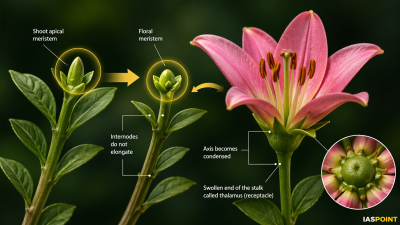
A flower is a modified shoot where the shoot apical meristem changes to a floral meristem. The internodes do not elongate, and the axis becomes condensed. The flowers are typically borne on a swollen end of the stalk called the thalamus (receptacle).
Floral Whorls
A typical flower consists of four distinct whorls arranged successively on the thalamus:
- Calyx (Sepals): The outermost whorl. Generally green and leaf-like; protects the flower in the bud stage.
- Corolla (Petals): Usually brightly colored to attract pollinators.
- Androecium: The male reproductive organ consisting of stamens. Each stamen has a filament and an anther (usually bilobed) containing pollen sacs.
- Gynoecium (Pistil): The female reproductive organ made of one or more carpels. A carpel consists of three parts: Stigma (receptive surface), Style (elongated tube), and Ovary (enlarged basal part containing ovules).
Classification Based on Symmetry (Phyllotaxy)
The geometric arrangement of floral parts is a frequent topic in UPSC Prelims.
- Actinomorphic (Radial Symmetry): Can be divided into two equal radial halves in any radial plane passing through the center. Examples: Mustard, Datura, Chilli.
- Zygomorphic (Bilateral Symmetry): Can be divided into two similar halves only in one particular vertical plane. Examples: Pea, Gulmohar, Bean, Cassia.
- Asymmetric (Irregular): Cannot be divided into two similar halves by any vertical plane passing through the center. Example: Canna.
Classification Based on Floral Appendages
Flowers are categorized by the number of appendages in each whorl (trimerous, tetramerous, or pentramerous) and the presence of bracts.
- Bracteate: Flowers with bracts (reduced leaves found at the base of the pedicel).
- Ebracteate: Flowers without bracts.
Position of Floral Parts on Thalamus (Ovary Position)
This classification is critical for understanding the difference between superior and inferior ovaries. [Image showing Hypogynous, Perigynous, and Epigynous flowers]
- Hypogynous: The gynoecium occupies the highest position while other parts are situated below it. The ovary is Superior. Examples: Mustard, China rose, Brinjal.
- Perigynous: The gynoecium is situated in the center and other parts are located on the rim of the thalamus at almost the same level. The ovary is Half-inferior. Examples: Plum, Rose, Peach.
- Epigynous: The margin of the thalamus grows upward enclosing the ovary completely and getting fused with it; other floral parts arise above the ovary. The ovary is Inferior. Examples: Guava, Cucumber, ray florets of Sunflower.
Technical Terms in Reproductive Morphology
| Term | Description |
| Bisexual | Flower possesses both stamens and carpels (Hermaphrodite). |
| Unisexual | Flower possesses either only stamens (staminate) or only carpels (pistillate). |
| Aestivation | The mode of arrangement of sepals or petals in the floral bud with respect to other members of the same whorl. |
| Staminode | A sterile or underdeveloped stamen that does not produce pollen. |
| Apocarpous | Carpels are free (not fused). Examples: Lotus, Rose. |
| Syncarpous | Carpels are fused. Examples: Mustard, Tomato. |
Types of Aestivation
The arrangement of petals/sepals is a key diagnostic feature for plant families.
- Valvate: Sepals or petals touch each other at the margin without overlapping. Example: Calotropis.
- Twisted: One margin of the appendage overlaps that of the next one and so on. Example: China rose, Cotton.
- Imbricate: Margins overlap but not in any particular direction. Example: Cassia, Gulmohar.
- Vexillary (Papilionaceous): Found in peas; consists of a large “standard” petal, two lateral “wings,” and two fused “keels.”
Placentation Types
Placentation refers to the arrangement of ovules within the ovary.
- Marginal: Placenta forms a ridge along the ventral suture of the ovary. Example: Pea.
- Axile: Placenta is axial and the ovules are attached to it in a multilocular ovary. Example: Lemon, Tomato.
- Parietal: Ovules develop on the inner wall of the ovary. Example: Mustard, Argemone.
- Free Central: Ovules are borne on a central axis and septa are absent. Example: Dianthus, Primrose.
- Basal: Placenta develops at the base of the ovary and a single ovule is attached to it. Example: Sunflower, Marigold.
UPSC Trivia for Quick Revision
- Monocot Flowers: Usually show trimerous symmetry (parts in multiples of three).
- Dicot Flowers: Usually show tetramerous or pentramerous symmetry.
- Parthenocarpic Fruit: Fruit developed without fertilization, often from an unfertilized ovary (e.g., Banana).
- False Fruit: When the thalamus also contributes to fruit formation along with the ovary (e.g., Apple, Strawberry).