

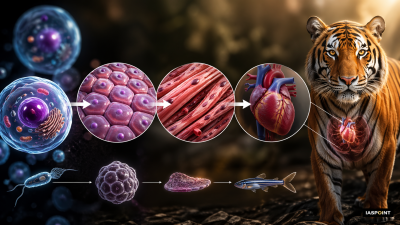
In the context of evolutionary biology, tissues represent a level of biological organization between cells and organs. A tissue is a group of similar cells from the same origin that together carry out a specific function. The transition from unicellularity to multicellularity necessitated the specialization of cells, leading to the “Division of Labour” within animal bodies.
Evolutionary Origin of Tissues
The evolution of tissues is closely tied to the transition from Protozoa (unicellular) to Metazoa (multicellular).
- Parazoa (Porifera): Sponges represent the first stage of multicellularity but lack “true” tissues. They exhibit a cellular level of organization where cells are functionally isolated.
- Eumetazoa (True Tissues): The first appearance of true tissues occurs in the Phylum Coelenterata (Cnidaria), such as jellyfish and hydra. These organisms exhibit the tissue level of organization.
- Triploblastic Evolution: Higher animals evolved three distinct germ layers, allowing for the complex organ-system level of organization seen in Platyhelminthes through Chordata.
Germ Layer Origins (Histogenesis)
The embryonic development of tissues occurs through a process called Histogenesis. In the animal kingdom, tissues are derived from one or more of the three primary germ layers.
| Tissue Type | Primary Germ Layer Origin | Examples in Animal Kingdom |
| Epithelial Tissue | Ectoderm, Mesoderm, and Endoderm | Skin epidermis, lining of the gut, gills. |
| Connective Tissue | Mesoderm | Bone, cartilage, blood (haemolymph in insects). |
| Muscular Tissue | Mesoderm | Skeletal muscles, cardiac muscles. |
| Nervous Tissue | Ectoderm | Brain, spinal cord, nerve net in Cnidarians. |
Classification and Functional Diversity in Animals
Epithelial Tissue
Epithelial tissues serve as protective coverings and secretory surfaces. In invertebrates and lower vertebrates, they play a critical role in respiration and osmoregulation.
- Squamous Epithelium: Found in the alveolar walls of lungfish and the lining of blood vessels.
- Ciliated Epithelium: Essential in the respiratory tracts of amphibians and the reproductive tracts of most vertebrates to move mucus or eggs.
- Glandular Epithelium: Specialized for secretion, such as the silk glands in spiders or venom glands in reptiles.
Connective Tissue
This is the most abundant and widely distributed tissue. In non-human animals, it exhibits unique adaptations:
- Skeletal Tissue: Provides structural support. Chondrichthyes (sharks) possess a purely cartilaginous skeleton, whereas Osteichthyes (bony fish) have ossified bone.
- Fluid Connective Tissue: In many invertebrates (like Arthropods), “Blood” is replaced by Haemolymph, which lacks hemoglobin and often uses hemocyanin (copper-based) for oxygen transport.
- Adipose Tissue: Crucial for thermoregulation in marine mammals (Blubber in whales/seals) and energy storage in camel humps.
Muscular Tissue
Muscular tissues enable locomotion, which is the hallmark of the animal kingdom.
- Striated (Skeletal) Muscle: Responsible for voluntary movements like the rapid wing beats of insects or the running of ungulates.
- Smooth Muscle: Controls involuntary actions such as peristalsis in the avian crop or the contraction of the swim bladder in fish.
- Cardiac Muscle: Specialized striated muscle found in the hearts of all vertebrates, characterized by inherent rhythmicity.
Nervous Tissue
The evolution of nervous tissue tracks the process of Cephalization (concentration of nervous tissue at the anterior end).
- Nerve Net: Found in Cnidarians (Hydra); the most primitive form of nervous tissue.
- Ganglionated Nerve Cord: Common in Annelids (earthworms) and Arthropods (cockroaches).
- Central Nervous System (CNS): Highly developed in Chordates, consisting of a hollow dorsal nerve cord.
Comparative Summary of Animal Tissues
| Feature | Invertebrates (e.g., Insects/Worms) | Lower Vertebrates (e.g., Fish/Amphibians) | Higher Vertebrates (e.g., Birds/Mammals) |
| Respiratory Tissue | Often tracheal tubes or skin. | Gills or moist skin (Cutaneous). | Lungs with high alveolar surface area. |
| Skeletal Support | Exoskeleton (Chitinous). | Endoskeleton (Cartilage/Bone). | Endoskeleton (Highly ossified bone). |
| Circulatory Fluid | Open system (Haemolymph). | Closed system (Hemoglobin in RBCs). | Closed system (Highly efficient 4-chambered heart). |
| Nervous Control | Ventral nerve cord. | Dorsal nerve cord. | Highly developed Cerebrum/Cerebellum. |
Important Facts and Trivia for Prelims
- Regeneration Power: Simple animals like Planaria (Platyhelminthes) possess extraordinary tissue regeneration capabilities due to a high concentration of stem cells called neoblasts.
- Diploblastic vs. Triploblastic: Cnidarians and Ctenophores are Diploblastic (two layers: Ectoderm and Endoderm). All higher animals from flatworms onwards are Triploblastic (three layers).
- The “Nerve Net”: Hydra is the first animal to evolve a nervous system, but it lacks a brain; it uses a decentralized nerve net.
- Haemocyanin: Unlike the iron-based hemoglobin in vertebrates, many mollusks and arthropods use copper-based haemocyanin, which turns blue when oxygenated.
- Chitin: The exoskeleton of arthropods is made of Chitin, a complex carbohydrate, which is technically a modified epithelial secretion rather than a living tissue.