

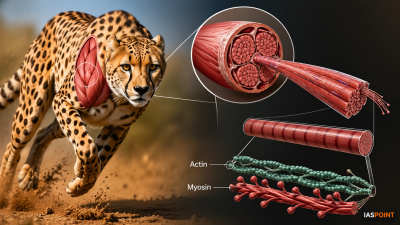
Muscular tissue is a specialized tissue of mesodermal origin responsible for movement and locomotion in the animal kingdom. It is composed of highly elongated cells called muscle fibers, which contain contractile proteins—actin and myosin. The interaction of these proteins allows the tissue to contract and relax in response to nerve impulses.
Classification of Muscular Tissues in Animals
Muscular tissue is categorized into three distinct types based on their structure, location, and the nature of control.
1. Skeletal Muscle (Striated / Voluntary)
These muscles are attached to the skeletal framework (exoskeleton or endoskeleton) and are under the conscious control of the nervous system.
- Structure: Long, cylindrical, unbranched, and multinucleated fibers with distinct transverse alternate light and dark bands (striations).
- Animal Adaptations:
- Insects: Possess highly efficient striated muscles attached to their chitinous exoskeleton. In flying insects, these muscles can contract at frequencies exceeding 1000 Hz.
- Birds: The Pectoralis major (breast muscle) is a massive skeletal muscle responsible for the powerful downstroke during flight.
- Fish: Arranged in segments called Myotomes (W-shaped blocks), allowing the lateral undulatory movement of the body for swimming.
2. Smooth Muscle (Non-striated / Involuntary)
These muscles are found in the walls of hollow internal organs and are not under voluntary control.
- Structure: Spindle-shaped (fusiform) cells with a single central nucleus and no striations.
- Animal Adaptations:
- Digestive Tract: Facilitates peristalsis in the esophagus and intestines of all vertebrates and most invertebrates (like annelids).
- Gizzard: In birds and earthworms, thick smooth muscles in the gizzard help in grinding food particles.
- Mollusks: The adductor muscles of bivalves (clams/oysters) are powerful smooth muscles that can keep the shell tightly closed for extended periods with minimal energy expenditure (catch mechanism).
3. Cardiac Muscle (Striated / Involuntary)
A specialized tissue found exclusively in the heart of vertebrates.
- Structure: Short, cylindrical, branched fibers with a single nucleus. They feature Intercalated Discs, which are specialized cell junctions that allow rapid transmission of electrical impulses.
- Animal Adaptations:
- Ectotherms (Reptiles/Amphibians): Cardiac tissue is adapted to function efficiently across a wide range of body temperatures.
- Mammals/Birds: The cardiac tissue is highly vascularized to support the high metabolic demand of maintaining a constant body temperature (endothermy).
Comparative Functional Matrix
| Feature | Skeletal Muscle | Smooth Muscle | Cardiac Muscle |
|---|---|---|---|
| Shape | Cylindrical | Spindle-shaped | Branched Cylindrical |
| Striations | Present | Absent | Present |
| Nucleus | Multinucleated (Peripheral) | Uninucleated (Central) | Uninucleated (Central) |
| Control | Voluntary | Involuntary | Involuntary |
| Action | Rapid contraction; Fatigues easily | Slow contraction; Never fatigues | Rhythmic; Never fatigues |
| Primary Role | Locomotion (Running, Flying) | Internal movements (Digestion) | Blood circulation |
Evolutionary Evolution of Muscular Tissue
- Cnidarians (Hydra/Jellyfish): Lack true muscle fibers. They use Epithelio-muscular cells, which have contractile bases. This is the most primitive form of “muscular” action.
- Annelids (Earthworms): Use a combination of circular and longitudinal muscles to alter body shape and move via hydrostatic pressure.
- Arthropods: The first group to evolve complex striated muscles attached to an exoskeleton, enabling sophisticated joints and flight.
- Vertebrates: Exhibit the highest degree of muscular specialization, including distinct muscle groups for posture, respiration, and rapid locomotion.
Key Facts for UPSC Prelims
- Sarcoplasm & Sarcolemma: The cytoplasm of a muscle fiber is called Sarcoplasm, and its plasma membrane is the Sarcolemma.
- Myoglobin: A red pigment that stores oxygen in muscle tissues. It is found in high concentrations in the “Dark Meat” of birds and the muscles of deep-diving mammals like seals.
- Rigorous Flight: The flight muscles of birds are packed with Mitochondria (the powerhouses of the cell) to provide continuous ATP for long-distance migration.
- Electric Organs: In certain fish (e.g., Electric Eel), muscular tissue is modified into Electrocytes—stacks of cells that generate electricity instead of mechanical force.
- Red vs. White Muscles: * Red Muscles: High myoglobin, slow-twitch, high endurance (e.g., migratory bird wing muscles).
- White Muscles: Low myoglobin, fast-twitch, quick bursts of energy (e.g., domestic chicken wing muscles).